For similar MVP engagements, see Startup & MVP development services.
Decision Context
Building any AI-assisted outbound tooling in the EU carries real operational and regulatory weight, and we wanted to be honest about that from the start.
We deliberately rejected the "AI does the work" framing. Tools that send messages on their own, scrape personal data or run mass-outreach without a human in the loop create risk for the sender and noise for the recipient. We wanted something that makes a small team faster without removing human judgement from any outbound step.
Constraints we set at the start:
- No autonomous outbound sending — every message is reviewed and approved by an operator first.
- No scraped personal data and no purchased lists used without operator review of source and basis.
- Decisions made with AI assistance must be explainable and reviewable, not opaque.
- Experimentation data must be structured enough to be interpreted honestly, not used to manufacture vanity numbers.
The tool was designed with human review, traceability and operator control as first-class concerns. AI is positioned as an assistive layer — it drafts, suggests and summarises — while every sensitive action stays with the operator.
What the tool actually does
LEAD LAB supports day-to-day revenue operations work for a small team: surfacing relevant account context, scoring accounts against an ideal-customer profile, proposing outreach drafts, and keeping CRM data tidy. The work is structured around traceability and GDPR-aligned handling of contact data, so it fits an EU operating context.
What it helps with:
- Centralised view of accounts, contacts, campaigns and interactions for the operator
- AI-assisted account research and scoring drafts the operator reviews and edits
- Outreach drafts proposed by AI and confirmed by a human operator before any send
- Flags on risky outreach patterns (high volume per domain, repeated touches, lookalike-spam patterns) that require operator confirmation
- Operator-controlled sender domains, opt-out handling, frequency caps and unsubscribe paths
The intent is less manual research per account and lower-friction outreach preparation, not a guaranteed pipeline. The operator stays in control of what actually goes out.
Specialised AI Components
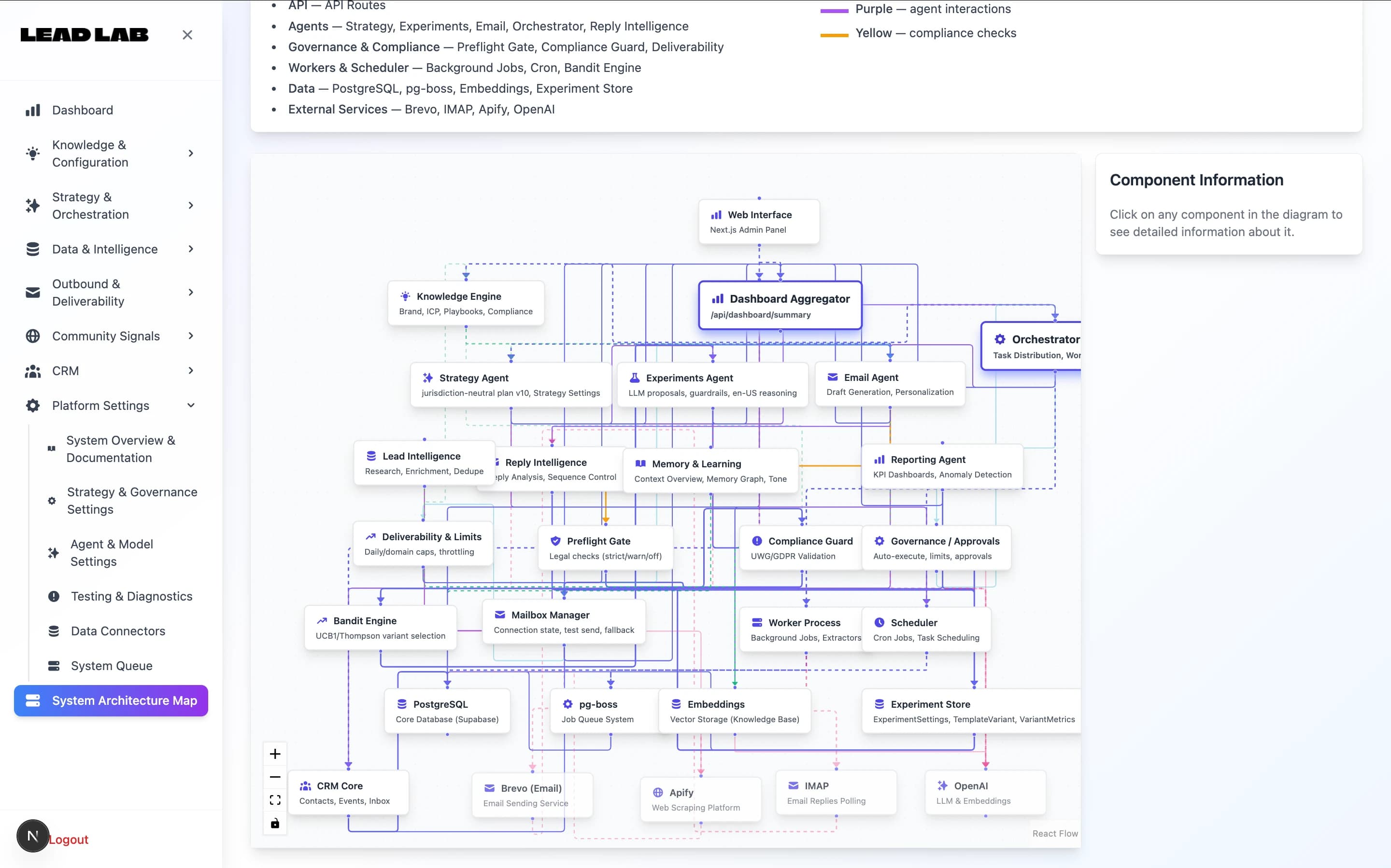
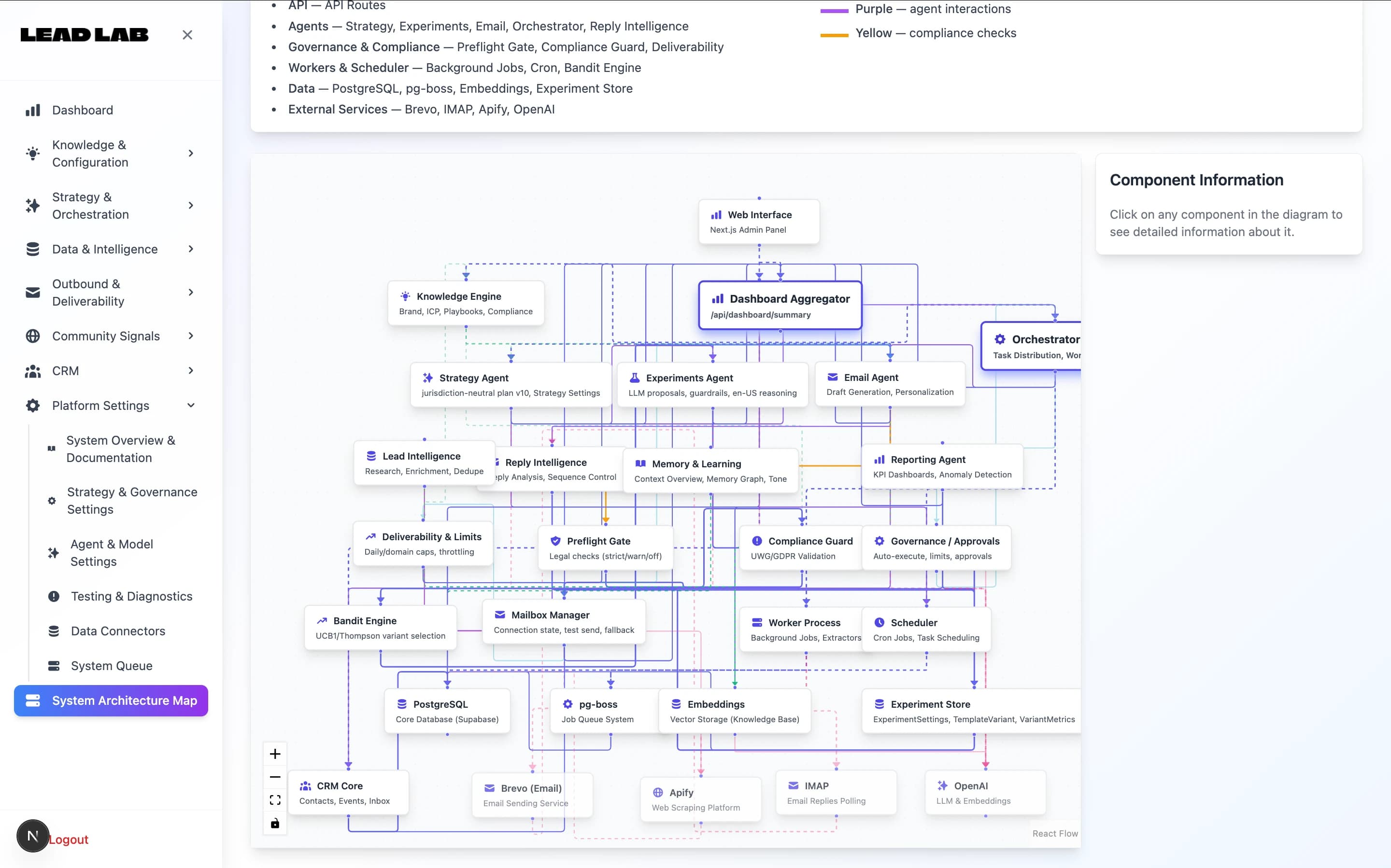
Internally, the tool uses several specialised AI components, each with a narrow job: preparing research notes, proposing account scores, drafting outreach copy, summarising replies or supporting CRM hygiene. The responsible operator sets the boundaries. AI can produce low-risk, reversible outputs such as notes, summaries and drafts. Anything that affects a recipient or external data source — a send, a sending-domain change or adding a contact — requires explicit human approval. This lets a small team prepare more relevant accounts carefully without handing responsibility for outbound communication to an automated system.
Governance and Data Handling
Data handling and outbound governance were built in from day one, not bolted on. The tool includes a governance layer covering:
- GDPR-aligned handling of contact data, with clear basis for use and operator-controlled retention
- Risk flags and operational limits on outbound volume, frequency and domain reuse
- Internal audit logs of AI suggestions and operator decisions, so a step can be reviewed later
- Human approval required for any send, any data import from an external source, and any new sender domain
This is governance for our own operating context — it does not certify any external party as GDPR-compliant. Account research synthesises publicly available data; no scraped personal data and no purchased lists are used without operator review. Stored data is minimised to what the operator needs, and retention is reviewed quarterly.
Technical Setup
The tool is implemented as a pnpm monorepo with several coordinated applications and shared packages — web interfaces, background processing, data ingestion, core business logic and enrichment services. It is built for steady operation by a small team, not for unbounded scale. The stack uses modern frontend frameworks, structured backend services, a shared data model and AI-assisted logic where it earns its keep. Infrastructure choices favour observability and controlled operation over open-ended automation.
Operating Context
LEAD LAB was built and is used internally to support a small B2B team's revenue operations work. The point of the project is to show how AI can be brought into outbound and account workflows in a way that makes an operator faster without removing the operator. The outcome we care about is internal: less repetitive manual research, cleaner CRM data, more considered outreach. We are deliberately not positioning this as a lead-generation engine that delivers a number to anyone.
What we built
- Internal AI-assisted revenue operations tool with humans in the loop
- Multi-component AI setup with operator-controlled boundaries
- Account research, scoring, outreach drafting and CRM hygiene workflow
- GDPR-aligned data handling and governance layer for our own use
- Structured experimentation and review of outreach hypotheses
- Internal analytics and reporting on operator workload and outbound hygiene
- Operator-controlled outbound: sender domains, opt-outs, frequency caps, unsubscribe paths
- Pnpm monorepo codebase maintained by a small team
What We Learned from Internal Use
In our own workflow, the tool reduces repetitive research and data-maintenance work and creates one traceable path from account review to an approved draft. The value is better-prepared context, cleaner CRM records and clearer decisions. This describes our internal operating model, not a promise of leads, meetings or revenue: results still depend on the market, the offer, data quality and careful human work.