
01
Launch-ready MVP products
Authentication, account and role model · Core user journeys · Database and backend foundations · Production deployment · Release-ready V1 built for real users rather than a presentation prototype

Production-ready MVP software development for founders and teams building SaaS products, customer portals, marketplaces or workflow platforms — with backend logic, billing, admin workflows, deployment and a codebase designed for the next stage of growth.

A fast launch should not create an expensive second start.
Authentication, account and role model · Core user journeys · Database and backend foundations · Production deployment · Release-ready V1 built for real users rather than a presentation prototype
Subscription billing or payment flows where required · Admin tools · Organisation and tenant setup · Onboarding states · Reporting, notifications and operational controls
SaaS dashboards · Client portals · Booking and workflow products · Marketplaces · Document generation and approval flows · Internal tools needed to run the product behind the interface
Payment providers, CRM or third-party APIs · Error tracking and structured logging · Critical-path testing · CI/CD and deployment setup · Architecture documentation and code handover
In-app copilots and assistants · Smart forms and assisted data entry · RAG-style search over your product's own data · Document parsing and generation in-flow · Built on your stack (Next.js + provider API), vendor-neutral, with human review on anything that affects users or money
V1 goal, users, roles and workflows defined • Data model, integration boundaries and risks mapped • Release priorities agreed before development starts
Wireframes and user journeys • Admin flows and operational tooling planned • Controlled MVP scope from v0.1 to launch-ready V1
Frontend, backend, database and APIs built as one product system • Payments, integrations and analytics wired in • Admin tools and internal workflows delivered alongside the product
Deployment, performance and security basics • Analytics and tracking setup before launch • Post-launch iteration cycles so the product keeps improving
The Architecture Sprint delivers: a scoped V1 feature map, user roles and core workflows, an architecture recommendation, an integration and risk map, delivery phases and a handover-ready decision document. Final scope depends on requirements, integrations, timeline, operational responsibilities and review needs; if we recommend a different team or approach, you keep the architecture document.
Startups that gain traction often face technical review during fundraising, enterprise procurement, security assessments or partner onboarding. At that stage, teams are asked to explain architecture decisions, data handling, access control, deployment and operational reliability. We build the first version with those questions in mind, so future review starts from documented decisions rather than reverse-engineering an undocumented product.
Documented architecture decisions (ADRs) explaining the major choices
Tenant isolation strategy described and verifiable in code
Auditability and observability across critical user, admin and billing actions
Sub-processor inventory ready for DPA / DD review
Test coverage on critical paths (auth, billing, tenant boundaries)
Incident history and post-mortems where applicable
Many MVPs hit technical problems before product-market fit is truly clear. We build the minimum architecture that supports the transition to real paying customers.
An MVP is not only a prototype or a reduced interface. For a software product that will be used by real customers, the first release often needs authentication, roles, data structure, admin operations, integrations, deployment and a clear handover path.
We build MVP software around the smallest viable product scope that can be launched, operated and extended without immediately rebuilding the foundation.
The smallest complete journey real users need in order to sign up, use the product and reach its core value.
APIs, database structure, roles and system boundaries designed for the confirmed V1 scope.
The internal tools needed to manage users, content, exceptions, payments or support after launch.
Deployment, monitoring foundations, documentation and technical ownership prepared from the first release.
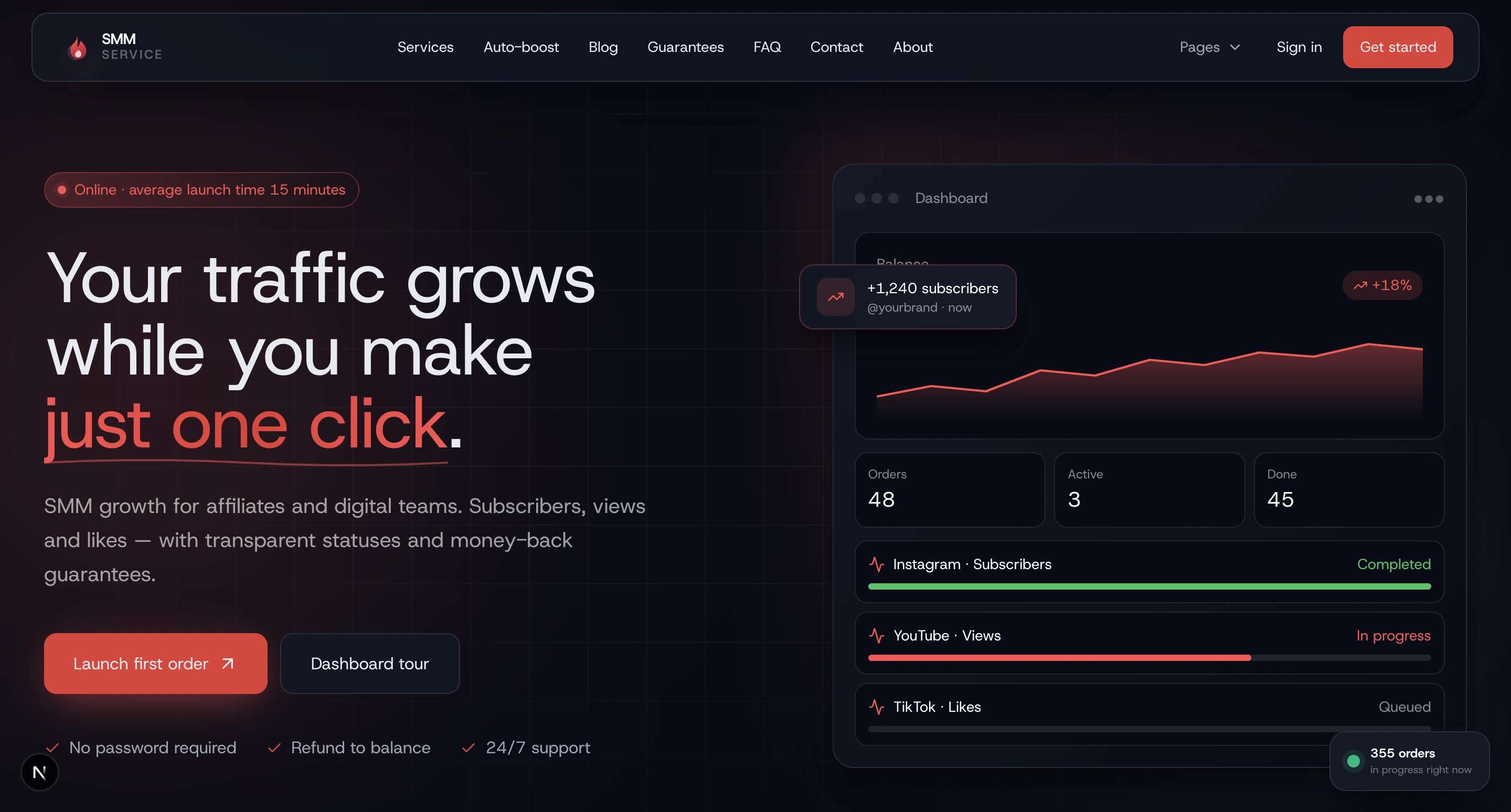 Startup EngineeringCreator Marketing Platform - Engagement Services MarketplaceEnd-to-end engineering for a multi-tenant creator marketing platform: Java Spring backend, Next.js dashboard, admin console, and a provider-aggregated catalog of 1,200+ services across thirteen platforms.Read case study
 Startup EngineeringWeb Page Generator - SaaS Publishing Platform for QR & URL CampaignsSaaS publishing platform for generating dynamic web pages connected to QR codes and custom URLs, with structured page management, campaign logic, and admin-controlled publishing workflows.Read case study
Minimum Viable Architecture is the smallest technical foundation that lets an MVP launch, serve real users and evolve without forcing an immediate rebuild. It is not enterprise-perfection — it is the early decisions that are expensive to reverse later: account and role model, data model, deployment, integrations and operational visibility. Just enough that the V1 isn't already a rewrite target on day one.
We start with a free scoping call and a short initial assessment. If the product is clear enough, we scope the first build directly: a Lean MVP / V1 (6–10 weeks), a Production MVP (10–16 weeks) or a B2B SaaS V1 with diligence-ready engineering artefacts (14–20 weeks). A paid 5-day Architecture Sprint is optional when multiple domains, integrations or material delivery risks require a reusable decision document; its fee credits toward project work if we proceed together.
Initial assessment: free for an understandable scope. Optional Architecture Sprint: 5 days where deeper product and system decisions are needed. Lean V1: 6–10 weeks. Production MVP: 10–16 weeks. B2B SaaS V1 with diligence-ready engineering artefacts: 14–20 weeks. Faster than the lower bound usually means scope cuts that show up as rewrite pressure later.
Java/Spring when your roadmap includes enterprise B2B sales (DACH financial services, regulated B2B, banking customers expecting JVM-based security audits). Node when general B2B SaaS — faster to staff, smaller ops footprint, better default for product velocity. We help you decide in the Architecture Sprint.
Yes. We can include Stripe, PayPal, Paddle or other payment providers where billing is part of the product model, and we design payment and subscription states explicitly so pricing, access, refunds and admin visibility do not become hidden edge cases. Admin tools and operational workflows are built alongside the product, not bolted on after launch.
Yes. After launch we can continue with feature iterations, technical cleanup, monitoring, analytics, integrations and roadmap support. The goal is to keep the product moving without creating dependency on undocumented code.
Common engagement. We can take over from prototypes, Figma designs, partial codebases or early no-code experiments — assess what's there, then either help finish or restart on the right foundation. For a small, understandable codebase, the initial assessment is free and we can often propose a focused first task directly. A paid Architecture Sprint is used only when reuse, production risk or several systems need deeper documented analysis. For acute cases — failed contractor, stuck rewrite — see our Software Rescue service.
Often yes. Architecture decision records (ADRs), audit logs, sub-processor inventory, tenant isolation documentation, deployment history and basic test coverage can all support technical review during fundraising, enterprise procurement or partner onboarding. Some engagements target diligence-oriented documentation over a 90-day milestone.
Yes. When AI is core to the product — a copilot, assisted workflow or smart search — we design it into the architecture during the build, on the same stack, with human review where outputs affect users or money. It's an extension of the MVP scope, not a separate engagement.
We're vendor-neutral. The provider (Anthropic, OpenAI, others, or EU-hosted / local where data sensitivity requires it) is a per-use-case decision made in the architecture phase — not a default and never tied to partner status.
Yes. AI-native means AI built into a new product as we build it. AI automation adds AI to systems you already run. Same capability, different stage.
More insights and best practices on this topic.
Post-mortems blame 'no market need' — but there's a quieter killer: the MVP becomes technically unusable as a foundation before PMF arrives. Why Minimum Viable Architecture matters, and how to build an MVP you can iterate on instead of rebuild.
Read→What B2B SaaS startups really are — core concepts, business models, the German-market specifics, and practical tips for sustainable growth.
Read→"Move fast" is a half-truth. Speed without architecture doesn't fail early — it fails exactly when momentum should compound. Why real velocity is a function of changeability, and how to stay fast when everyone else stalls.
Read→Technical debt isn't a code-quality issue engineers complain about — it's a business-model problem that quietly rewrites how fast you can learn, decide, and change. Why it's a board-level constraint, and why governance beats rewrites.
Read→Planning a startup MVP or SaaS V1? We begin with a free initial assessment when the scope is understandable. Straightforward projects can move directly into a focused build; complex products may use a separately agreed Architecture Sprint to document scope, workflows, technical decisions and delivery risk.