

The SaaS architecture behind a B2B product decides whether the platform holds up under load or breaks under customer expectations. CTOs and product leaders who know the SaaS architecture best practices and apply them consistently avoid expensive rework, head off security gaps and lay the technical foundation for scalable growth. This guide is written for product managers and CTOs in B2B companies who need to make grounded decisions on multi-tenancy, API design, security architecture and extensibility. The concepts covered are field-tested and directly applicable.
Key takeaways
| Point | Details |
|---|---|
| Pick the multi-tenancy model deliberately | The pool model saves on cost but demands strict tenant isolation at every architectural layer. |
| Set up API monitoring from day one | Missing observability on APIs is one of the most common causes of scaling failures in SaaS systems. |
| Anchor Zero Trust as an architectural principle | Security isn't a feature added later — it has to flow into design decisions from the start. |
| Plan extensibility structurally | Extension points with explicit trust boundaries prevent instability during zero-downtime deployments. |
| Use cloud-native tools deliberately | AWS and Azure services for IAM, monitoring and cost allocation cut in-house engineering effort significantly. |
SaaS architecture best practices: multi-tenancy models
The choice of multi-tenancy model is the most consequential early architectural decision in B2B SaaS. It shapes operating costs, data isolation and the later ability to offer individual customer customisations. Multi-tenancy models such as Pool, Bridge and Silo drive cost, security and scaling outcomes in a fundamental way.
Pool, Silo and Bridge compared
| Model | Infrastructure | Cost | Isolation | Best for |
|---|---|---|---|---|
| Pool | Shared resources | Low | Logical (risky) | Many smaller customers |
| Bridge | Dedicated DB clusters | Medium | Strong | Enterprise with compliance |
| Silo | Fully separated stacks | High | Complete | Regulated industries |
The pool model is the most cost-efficient because every tenant shares one infrastructure. The flip side: a bug in the authorization layer or database filter can mean tenant A sees tenant B's data. That risk isn't theoretical. Mistakes in authorization and the data layer lead to serious data leaks in pool models.
The bridge model gives enterprise customers dedicated database clusters without duplicating the entire stack. It works especially well for B2B vendors with few but high-revenue large customers. The silo model separates everything fully and makes sense where regulation — GDPR, HIPAA, ISO 27001 — demands complete data separation.
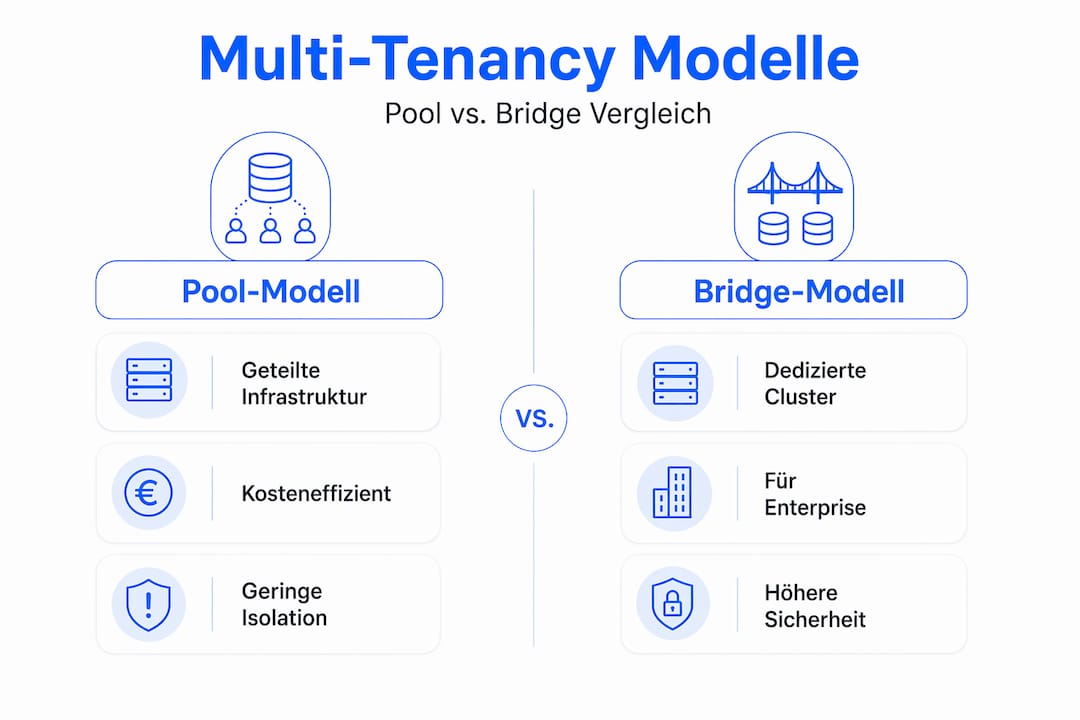
Recommendation for B2B SaaS: most platforms start with the pool model and build out a bridge path for enterprise customers. What matters is that the tenant ID is embedded from day one in every database query, log line and authorization filter. Retrofitting it later is disproportionately expensive. Teams who plan early benefit long-term from stable SaaS scaling and compliance.
API architecture: design, versioning and monitoring
A well-designed API architecture is the backbone of any scalable SaaS platform. API monitoring from day one and lean, targeted caching strategies are, in practice, non-negotiable for avoiding scaling failures.

API types and where they fit
The choice between REST, gRPC and GraphQL doesn't follow trends — it follows the actual use case:
- REST suits public APIs and integrations where interoperability and readability matter most.
- gRPC is the right choice for internal microservice communication with high throughput and low latency.
- GraphQL solves over- and under-fetching problems in complex frontends, at the cost of server-side complexity.
Versioning needs to be planned from the start. Splitting API versions cleanly via URL paths (for example /v1/ and /v2/) or via headers protects existing integrations when changes ship. Without a versioning plan, every breaking change threatens the operation of existing customers. In B2B contexts with long contract terms that's particularly damaging.
API architectures usually don't fail because features are missing — they fail because monitoring, versioning and performance feedback are missing. Metrics like response time, error rate and request volume per endpoint aren't optional extras. They're the foundation of every incident response.
Caching, finally, needs to be applied selectively. Not every endpoint benefits from caching. Misapplied caching causes inconsistent data, which has serious consequences in B2B environments with critical business workflows. Detailed guidance on API architecture types for SaaS helps with the right call.
Pro tip: Set up alerting for P95 latency and error rate per API endpoint from day one. Reacting only when customers complain costs you twice — reputational damage plus technical debt.
Security architecture: Zero Trust, IAM and audit
Security isn't an add-on shipped later. The Azure Well-Architected Framework recommends Zero Trust and the CIA model as the foundation for security in cloud SaaS architectures. Zero Trust concretely means: no user and no system gets trust based solely on its network position.
For B2B SaaS providers, that produces a clear priority list:
- Strong authentication. MFA blocks over 99.9 percent of attacks that rely on compromised credentials. WebAuthn and FIDO2 offer phishing-resistant alternatives to SMS-based methods.
- Provide SSO and SCIM 2.0 for enterprise customers. Large customers expect SSO as a baseline. SCIM automates access provisioning and de-provisioning to meet SOC 2 requirements and cuts administrative overhead significantly.
- Implement tenant-isolated logging. Every log entry must carry a tenant ID. Only then can incidents be analysed and audited in isolation without affecting other customers.
- Run security design reviews structurally. Checklists and structured review processes meaningfully improve compliance and architectural documentation. Microsoft recommends integrated review frameworks as part of the development process.
- Integrate IAM and threat detection. Azure services like Microsoft Defender and Entra ID Protection provide layered threat detection that would be disproportionately expensive to build in-house.
Pro tip: Tenant-aware logging and rate limiting are often the most expensive retrofits in mature SaaS projects. Integrating both from the start cuts debug time on incidents and saves more total time than the initial investment costs.
For deeper practical guidance on how to put this in place, see the IT security in SaaS guide for founders and CTOs.
Extensibility and hot reload in multi-tenant systems
Enterprise SaaS platforms need to support extensions and updates without interrupting running operations. That sounds trivial but is in practice one of the most complex areas of SaaS architecture. Extensibility in multi-tenant SaaS requires strict architectural principles for hot reload and isolated extension points.
The core principles are:
- Extension points instead of direct coupling. Extensions hit defined interfaces, not internal implementation details. That shields the core system from unintended side effects caused by third-party extensions.
- Distinguish in-process vs. out-of-process. In-process extensions run inside the same process as the core application and deliver low latency. Out-of-process extensions run in separate processes and provide better isolation. The choice depends on trust level and performance requirements.
- Implement in-flight tracking. In-flight tracking prevents failures during hot reload. Running user requests are completed in full before new code is activated. Without this mechanism, inconsistent states appear that are hard to debug.
- Model trust boundaries explicitly. Which extensions get access to which tenant data? That question has to be answered in the framework, not case by case.
- Enforce tenant isolation at the extension layer. A broken extension for tenant A must not affect operations for tenant B. That requires sandboxing and clear per-tenant resource limits.
These principles especially pay off for platforms with plugin ecosystems, marketplace models or per-customer configurations.
Recommended tools and cloud services
The best SaaS architecture builds on proven cloud primitives instead of developing everything in-house. The overview below shows which services cover which architectural area:
| Area | AWS services | Azure services | Purpose |
|---|---|---|---|
| Multi-tenancy | IAM Tagging, Aurora Serverless, EKS | Azure AKS, Managed Identity | Resource separation, scaling |
| API management | API Gateway, Lambda | Azure API Management | Routing, throttling, versioning |
| Security and IAM | AWS Cognito, IAM Policies | Entra ID, Microsoft Defender | Authentication, threat protection |
| Cost transparency | Cost Explorer, CUR 2.0 | Azure Cost Management | Tenant-level cost allocation |
| Monitoring | CloudWatch, X-Ray | Azure Monitor, Application Insights | Observability, alerting |
Tenant-level cost allocation through AWS Split Cost Allocation Data creates the transparency you need for pricing and optimisation. If you don't know what a single tenant costs, you can't price your offering on solid ground.
Cloud-native services have a decisive advantage over in-house builds: they're maintained, documented and scale automatically. The effort to build in-house solutions for IAM, monitoring or cost allocation gets systematically underestimated. AI strategies for SaaS growth can sit as an additional layer on top of this stable base without straining the core architecture.
Pro tip: Start with AWS Cost Explorer or Azure Cost Management and tag resources consistently with tenant IDs. The effort at project start is small, but later it gives you precise data for negotiating tailored pricing with enterprise customers.
What I've learned after years in SaaS consulting
In my work I've seen the same pattern over and over: teams put a lot of energy into features and too little into architecture. And then, usually somewhere between the fifth and tenth enterprise customer, the system collapses under the weight of its own decisions.
What surprised me most: the most expensive mistakes rarely come from a lack of knowledge. They come from the belief that tenant isolation, API versioning or security logging can be "added later". In rare cases that's technically true. In practice "later" almost always means a full refactor cycle under operational pressure.
One more point I think gets systematically underestimated: discipline in multi-tenant implementation. Picking the right model isn't enough. Every new feature, every new engineer, every new deployment has to follow the same tenant isolation rules. That's a cultural question as much as a technical one. Teams that plan for scalable systems early have a measurable advantage here over teams that only react when problems appear.
My advice: treat architectural decisions like contracts. Once defined and implemented, they're hard to undo. Choose models that fit your current customer profile but don't block growth.
— Anna
Scalable SaaS architecture with H-Studio Berlin
If you're a CTO or product manager facing the decision to build a SaaS platform from scratch or to upgrade an existing architecture for enterprise growth, the right engineering partner matters.
H-Studio Berlin is an architecture-focused software studio from Berlin supporting B2B SaaS teams in shipping scalable, privacy-aware, production-ready systems. From architecture planning through backend and API development to deployment strategy, H-Studio Berlin covers the full development path. The architecture and engineering service gives you a partner with technical depth and product understanding. For teams building with modern technologies, H-Studio Berlin also offers specialised modern web stack development focused on scalable, maintainable architectures. Use the project planner to scope your needs and plan the next step.
FAQ
What's the difference between the pool and silo models?
In the pool model, all tenants share one infrastructure, which reduces cost but demands strict logical data separation. The silo model runs a dedicated stack per tenant with complete physical isolation.
Why is API versioning so important in B2B SaaS?
B2B customers often have their own integrations that depend on stable API contracts. Without versioning, every breaking change threatens existing customer connections and breaks implicit contractual promises.
What does Zero Trust mean concretely for SaaS architectures?
Zero Trust means neither network position nor internal service status automatically grants trust. Every request is checked against identity, context and permissions, no matter where it comes from.
When should you use the bridge model instead of the pool model?
The bridge model fits when enterprise customers require dedicated database clusters for compliance or performance reasons, but a full silo stack is hard to justify economically.
How do you implement tenant isolation reliably?
Tenant IDs have to be embedded in every database query, every log entry and every authorization filter. Automated tests that specifically check for tenant crossing aren't optional — they're mandatory.
Further reading
- SaaS in B2B: architecture, scaling and compliance
- Secure SaaS architecture: the founder's guide
- SaaS scaling: architecture, growth and best practices
- The advantages of scalable software architecture
Edited and fact-checked by Anna Hartung.