
If you build a B2B SaaS product and treat security as a downstream task, growth can expose data-access gaps that were invisible during an early pilot. Security is rarely something you can bolt on like a standalone upgrade. This guide shows how founders and CTOs can build a risk-based, GDPR-aware security architecture and preserve evidence that its controls work.
Table of Contents
- Foundations of Secure Architecture for B2B SaaS
- Preparation: Tools, Methods, Requirements
- Step by Step: Implementing a Secure Architecture
- Verification: Continuously Auditing Security
- Field Notes: Why Security-by-Design Makes the Difference
- Mastering Secure Architecture with Experts
- Frequently Asked Questions on Secure Architecture
Key Takeaways
| Point | Detail |
|---|---|
| Implement Security-by-Design | Plan security early and systematically against established principles and checklists. |
| GDPR as architectural foundation | Every technical decision should reflect — and document — GDPR requirements. |
| Choose tools and methods deliberately | Use vetted automation and checklist tools to build a robust security architecture. |
| Continuous security verification | Integrated tests and ongoing checks sustain compliance and protection. |
| Expert help for complex cases | Where uncertainty is real, professional advice is the cheapest investment in your product and your customers. |
Foundations of Secure Architecture for B2B SaaS
Secure software architecture doesn't start with tools or checklists. It starts with a design decision: treating security as a structural property of the system, not as a protective layer added later.
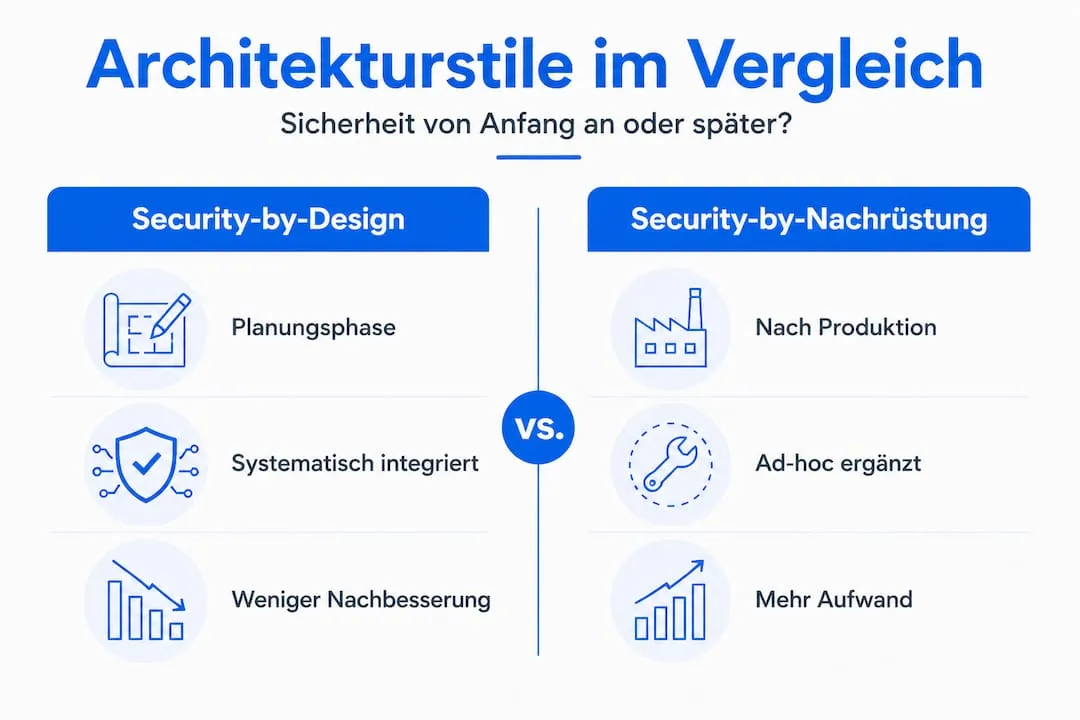
Security-by-Design vs. Security-by-Default
The two concepts are often conflated, but they describe different things. Security-by-Design means that security principles are actively considered throughout planning and development. Every architectural decision is paired with one question: how can this subsystem be attacked, and how do we eliminate the attack surface up front?
Security-by-Default describes the initial state of a deployed system: unnecessary access is disabled, permissions are narrow and protective controls do not depend on every customer discovering an advanced setting. Germany's BSI software-development guidance includes secure system design and secure defaults among its baseline requirements. For web applications, OWASP ASVS provides a current, testable catalogue of technical security requirements. The appropriate scope still depends on the product's risks and regulatory context.
| Trait | Security-by-Design | Security as Retrofit |
|---|---|---|
| Timing | Planning phase | After production release |
| Cost profile | Planned engineering work | Unplanned change and incident work |
| Effectiveness | Structural | Locally limited |
| Evidence | Controls can be documented as they are built | Evidence often has to be reconstructed |
| Scalability | Considered from day one | Forces a rewrite |
Core architectural principles
Three principles form the foundation of a secure system architecture for B2B SaaS:
- Separation of concerns: Each component has exactly one defined function. Authentication logic doesn't live inside business logic. Data access is isolated from presentation layers.
- Modularity: The system is composed of decoupled building blocks that can be updated, audited and replaced independently. A security incident in one module doesn't automatically spread to others.
- Least privilege: Each service, user and process gets only the permissions strictly required for its function. No broad admin roles by default.
GDPR Article 5 sets principles including data minimisation and purpose limitation. Article 32 requires technical and organisational measures appropriate to risk; it does not prescribe one universal architecture or require access logging in every system. Logging, encryption, resilience and recovery controls should be selected and documented according to the processing risks. Aligning a scalable software architecture with those requirements early makes later reviews easier, but legal compliance also depends on governance and actual operation.
"A secure architecture isn't a security product. It's a design property of the entire system, visible in every layer."
Other engineering perspectives on the topic show how leading teams operationalise these principles — and which architectural calls most often decide between long-term success and accumulating technical debt.
Preparation: Tools, Methods, Requirements
Before a line of code is written, the architecture should sit on a documented foundation. The preparation phase decides whether the resulting system is provably secure, or merely intuitively built.
Overview of architecture tools and methods
Choosing the right tools is a strategic decision, not a pure technical one. The following categories cover the entire security lifecycle:
- Threat modelling: STRIDE (Spoofing, Tampering, Repudiation, Information Disclosure, Denial of Service, Elevation of Privilege) is a proven framework for systematically identifying attack vectors. OWASP Threat Dragon supports visual modelling.
- Static code analysis (SAST): Tools like SonarQube or Checkmarx scan source code for known security patterns before the system runs.
- Dependency scanning: Snyk or OWASP Dependency-Check identify vulnerable libraries in the dependency chain — a risk often overlooked in startups.
- Infrastructure-as-Code review: Terraform configurations and Kubernetes manifests are checked with Checkov or Trivy for unsafe defaults.
- Penetration testing: Automated baseline scans with OWASP ZAP, complemented by manual penetration testing before critical releases.
| Tool category | Examples | When it's used |
|---|---|---|
| Threat modelling | STRIDE, OWASP Threat Dragon | Design phase |
| Static analysis (SAST) | SonarQube, Checkmarx | Development phase |
| Dependency scanning | Snyk, OWASP Dependency-Check | CI/CD integration |
| IaC security | Checkov, Trivy | Infrastructure planning |
| Dynamic tests (DAST) | OWASP ZAP, Burp Suite | Pre-release |
Define requirements clearly
Defining requirements before implementation isn't a bureaucratic act. It's the foundation for every security decision that follows. Three dimensions need to be captured fully:
Scalability: What load and abuse profiles are plausible? Rate limiting, session management and database access controls should have explicit limits, observability and a test strategy. Capacity assumptions can be revised as the product grows; the security boundary should not depend on an undocumented user-count guess.
GDPR requirements: Which data categories are processed? Where is data stored? Hosting in Germany or the EU is an architectural decision, not a later add-on. Data-processing agreements, deletion routines and access processes must be technically represented.
Security goals: What are the system's protected assets? Customer data, payment information, contracts? Each asset gets a defined protection level that drives architectural decisions. Practical implementation patterns help translate these requirements into concrete architecture.
A versioned verification standard such as OWASP ASVS helps a small team turn broad security goals into testable requirements and recorded evidence. Select only the controls justified by the system and record exclusions rather than claiming blanket compliance. The H-Studio knowledge library contains complementary resources for structured requirements analysis.
Pro tip: Tool selection should be aligned early with all relevant stakeholders. The most important deliverable is documenting the interfaces between security tools and the CI/CD pipeline. Gaps in interface documentation become audit gaps later.
Step by Step: Implementing a Secure Architecture
Implementing a secure architecture follows a clear sequence. Each step builds on the previous one and produces documentable security properties.
1. Foundation: Separation of Concerns in practice
The first implementation step is the structural separation of system components. In a typical Java/Spring Boot architecture, that means separate services for authentication, authorisation, business logic and data access. No service class takes on more than one of these roles.

In practice this is implemented as a layered architecture or via the ports-and-adapters pattern (hexagonal architecture). The latter has the advantage that security tests for each adapter can be written in isolation, without touching the core logic. For microservices-based systems, an API gateway is added as the central entry point — handling authentication and rate limiting before any downstream service.
2. Default Hardening: standardised protection
Every system starts in a maximally restrictive state. Concrete measures:
- HTTPS as the only allowed transport protocol; HTTP requests redirect automatically.
- Database connections only over encrypted channels with certificate validation.
- No direct database access from the public network — only via dedicated service layers.
- Vendor default credentials are removed or replaced before a component becomes reachable.
- Security headers (Content Security Policy, HSTS, X-Frame-Options) by default in every HTTP response.
3. Operational Integrity: automated security tests
Security isn't a one-time state. It must be verified at every deployment. In the CI/CD pipeline:
- Pre-commit hooks: Block secrets like API keys or passwords from being committed, using tools such as git-secrets or detect-secrets.
- Build phase: SAST scanners analyse code on every commit. Critical findings block the build.
- Test phase: Security-relevant unit and integration tests check access control, input validation and error behaviour.
- Deployment phase: IaC scans check infrastructure configurations before delivery. Unsafe Terraform modules are rejected.
4. Guided Protection: usable security for end users
A frequently neglected aspect is security guidance for end users. Bad UX around security functions produces unsafe user behaviour. Concretely:
- Clear password requirements with real-time feedback — no cryptic error messages after submission.
- Multi-factor authentication (MFA) as the recommended default, not a hidden option.
- Session management with transparent timeouts and clear communication about active sessions.
- Privacy settings that are accessible and understandable for users.
Pro tip: A common mistake is planning MFA only as a post-launch feature request. Integration costs for MFA rise sharply once the identity system is already in production. OAuth2/OIDC flows with MFA support should be planned from sprint one.
Finding an access-control or data-model flaw during design usually gives a team more options than discovering it after production data and customer integrations depend on the behaviour. The exact cost difference varies too much to express as a universal multiplier; the practical advantage is reduced migration and incident risk.
Concrete implementation examples across different industries and product domains show how these steps vary depending on the regulatory context. The blog on web engineering holds complementary technical write-ups for the implementation phase.
Verification: Continuously Auditing Security
After implementation, ongoing operations begin. Security isn't a static state a system permanently holds after a successful deployment. It has to be actively maintained, audited and documented.
Verification methods and release gates
A release gate is a defined checkpoint a change must pass before reaching production. Its controls should match the risk: a routine content change does not need the same evidence as an authentication rewrite. The team should document which findings block a release, who may accept residual risk and where the decision is recorded.
These verification methods belong in every process:
- Automated SAST, secret and dependency checks at points in the delivery pipeline where their findings can still block or inform a release.
- Dynamic tests and penetration tests at a cadence determined by exposure, customer commitments, material changes and applicable requirements.
- Continuous dependency monitoring with triage based on exploitability and product context, not only a raw CVE score.
- Configuration reviews for cloud infrastructure and Kubernetes clusters against CIS benchmarks.
- Data Protection Impact Assessments (DPIAs) where processing is likely to result in a high risk under GDPR Article 35, with the assessment connected to architecture decisions.
Collecting and documenting evidence
Documentation isn't bureaucracy. It's the operational memory of the system and the foundation for audits, investor conversations and customer certifications. Relevant evidence types:
- Scan reports: Exported SAST/DAST results with timestamps and version references.
- Penetration test reports: Findings with risk classifications and remediation evidence.
- Change logs for security measures: When was which configuration changed, and why?
- Security and access evidence: retained only for a documented purpose and period, with access controls for the logs themselves.
"Security documentation that can't be found when it matters has no value. Automated evidence collection isn't a comfort feature; it's an operational necessity."
Common verification mistakes to avoid
Three patterns appear especially often in practice:
- Audit only on suspicion: Security checks aren't run routinely, only after an incident. That eliminates the preventive effect.
- No clear ownership: It's unclear who in the team is responsible for executing and documenting security checks. Distributed responsibility is, in practice, no responsibility.
- Test coverage without business context: Automated tests check technical parameters but not whether access controls actually reflect the business rules. A user with the role "Guest" must not be able to invoke admin functions, even when the system is technically configured correctly.
Real startup project examples illustrate where these gaps emerge in practice and how they get closed structurally. Teams running complex data flows will also find security perspectives for data-centric components in our analytics pipeline approach.
Pro tip: Compliance checks in CI/CD should include both blocking and informational rules. Blocking rules prevent deployment on critical findings. Informational rules notify the security team about medium risks without halting development. The split avoids both security gaps and the productivity loss of overly restrictive automation.
Field Notes: Why Security-by-Design Makes the Difference
Security gaps often become visible only when the product adds roles, integrations, larger datasets or enterprise requirements. That does not mean every future incident was predetermined at launch; it means assumptions that were safe for a pilot need to be reviewed as the system changes.
User count alone does not create an access-control vulnerability. Exposure grows when more identities, permissions and integrations depend on a flawed check. Likewise, ISO 27001 certification is an organisation-wide management-system question, not something a single permission defect automatically blocks. Clear ownership and traceable remediation matter in both cases.
The actual difference between teams that successfully apply security-by-design and those that don't isn't technical knowledge. It's design discipline. The question "How can this go wrong?" gets asked at every architectural decision — not afterwards.
Another underestimated factor is security culture inside the team. Establishing security as collective responsibility is harder than implementing any single technical control. Teams that treat security as a quality property — not as the security officer's job — produce demonstrably more robust systems. That shows up especially in code review: when reviews systematically include security aspects, problems are caught before they reach production.
Preventive design takes time. Retrofitting takes considerably more — and not just in developer hours. A security incident during a growth phase consumes management capacity, damages customer trust, and can derail a fundraising round entirely. Founder teams that understand this early build systems that don't only launch securely, but scale securely too. That's the core of scalable software architecture as a strategic advantage.
Mastering Secure Architecture with Experts
Some founder teams can build this capability internally; others use an independent review for threat modelling, regulated processing or high-impact changes. External support is most useful when its scope, evidence and decision ownership are clear rather than replacing the team's responsibility.
H-Studio works with funded B2B SaaS startups to set this foundation correctly from day one. From an Architecture Sprint (5 days, €3,500) before MVP launch through long-term Engineering Partnership as an external senior team, we walk teams through every step of this guide. Our engineering services cover architecture reviews, GDPR-oriented technical implementation and DevOps integration. Teams planning enterprise-grade engineering from the start avoid the costly rewrite trap and create the conditions for Series-A-ready system quality. Talk to us before the first line of code is written.
Frequently Asked Questions on Secure Architecture
What does Security-by-Design concretely mean for SaaS startups?
Security-by-Design means security requirements and checks are integrated into design and delivery instead of being added only after an incident. BSI guidance and OWASP ASVS provide useful, testable baselines; the selected controls must still follow the product's actual risk profile.
How does GDPR shape architectural decisions?
GDPR defines data-protection principles and requires technical and organisational measures appropriate to risk, including Article 32. A versioned checklist can structure technical evidence, but it does not prove legal compliance on its own.
Which tools are recommended for security architecture?
Structured checklists and playbooks help with planning and verification; automated tools like SonarQube, Snyk and Checkov handle the technical implementation across SAST, dependency scanning and IaC review.
How do you integrate security checks efficiently into daily development?
Automated tests and CI/CD checks provide continuous control and documentation. Treat evidence as a release gate — no deployment without provable security checks — and split rules into blocking (critical) and informational (medium) to keep velocity.
Read more
This article is about the security-by-design and GDPR layer of SaaS architecture. The matching service tracks:
- Client Portals & Dashboards — secure user areas, RBAC, audit trails, GDPR-aligned data flows (the primary track for security-by-design surfaces)
- Custom Platforms & Business Apps — multi-tenant platforms with security as a first-class architectural concern
- Architecture Sprint · 5 days, €3,500 — fixed-scope review including the data and compliance map
- Building Production-Ready SaaS — broader launch-readiness checklist this article slots into