

Custom platform development for US teams building multi-user, data-driven products designed to grow.
Need a focused product build first? Start with web app development.

Platform-first architecture: designed around roles, permissions, data models, and long-term extensibility

Clean backend & APIs: stable APIs and backend logic that support multiple clients, integrations, and future services

Admin systems & control layers: back offices, moderation tools, and operational dashboards built in from the start

CI/CD & production setup: staging, deployments, monitoring, and observability included — not optional

Modular architecture (monolith or microservices, when justified)

Backend systems built for integrations and growth

Cloud infrastructure and observability

Security-first access control and data handling

Platform-first
Designed for multiple users, roles, and workflows.
Scalable
Platforms that grow with your business.
Production-ready
Stable under real-world load.
Ownership
You own the platform, codebase, and infrastructure.
Product capabilities
End-to-End Platform Engineering
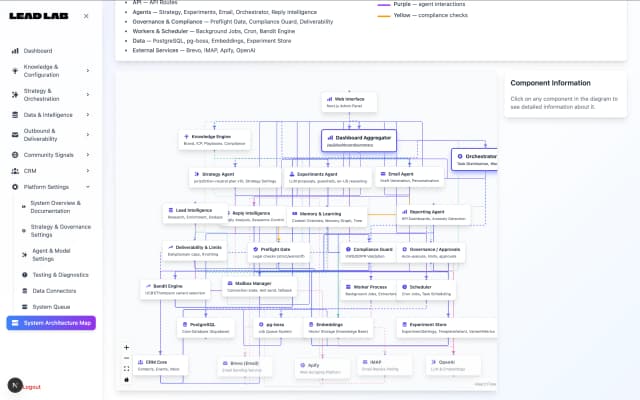
We design and build platforms — frontend, backend, infrastructure, and analytics — as one coherent system, not disconnected services.
- •SaaS and subscription platforms
- •Multi-tenant systems
- •Marketplaces and portals
- •Admin and moderation tools
- •Authentication, roles, and access control
- •CI/CD, staging, and production environments
Scalable Architecture & Infrastructure
Architecture designed for long-term platform growth.
- •Modular monoliths and microservices (when justified)
- •Cloud infrastructure and Kubernetes
- •Observability, monitoring, and alerting
- •Security-first access control and data handling

Automation, Data & Analytics
Platforms generate data — we make it useful.
- •Product and business analytics
- •Event tracking and dashboards
- •Data pipelines and reporting
- •Internal automation and integrations
What We Mean by "Platform"
A platform is not just a bigger app.
It's a system that:
- •serves multiple user types,
- •manages complex data relationships,
- •enforces permissions and workflows,
- •and acts as the backbone of a product or business.
Typical examples:
- • SaaS platforms
- • Marketplaces
- • Data platforms
- • Internal/external hybrid platforms
- • Multi-tenant business systems
Typical results from platform projects
Platforms remain reliable as users, data, and traffic increase.
Result: Stable Growth Under Load
New capabilities added without breaking existing functionality.
Result: Faster Feature Expansion
Admins and operators have visibility and control over the system.
Result: Operational Control
Platforms evolve without costly rewrites.
Result: Long-Term Maintainability
Engineering-first platform delivery
Custom platforms, not pre-packaged solutions.
Built for real-world complexity
Architecture designed for users, data, and integrations.
Production-ready by default
Security, reliability, and monitoring included.
Clear ownership
You own the platform, codebase, and infrastructure.
Long-term partner
Structured delivery, documentation, and ongoing support.
No vendor lock-in
Clean handover and future flexibility.
A clear path from idea to production-ready platform
1
Define the platform model
We align on users, roles, data, and growth expectations.
2
Build & launch
We implement frontend, backend, infrastructure, and core workflows.
3
Scale & evolve
We support growth, new features, and increasing complexity.
Results we're
proud to show






What Founders
Say
“Our team at Sovrn and Bali Villa Hub needed a tech partner who could think strategically — not just code. H-Studio built a scalable backend and lead pipeline for our investment platform, integrating property data, analytics, and client workflows. The result is a scalable ecosystem that significantly reduced manual effort and improved operational consistency.”

Octavius Ra, Founder at Sovrn Project / Bali Villa Hub Toronto / Bali
“Working with H-Studio felt like having a technical co-founder. They understood AI product logic right away — syncing our app, dashboards, and marketing flow. ChronoAI's beta now runs smoothly across users with stable performance and real-time analytics during beta operations. That level of execution is rare.”

Nikole Mireku Djima, CEO at Vortek.tech / ChronoAI Los Angeles, USA
“When I started Twin Palms, most of our bookings came from different channels — and it was chaos. H-Studio built a unified system that connects inquiries, bookings, and payments in one place. Many processes now run automatically — from guest communications to analytics — giving us a much clearer operational overview. It feels like we finally have a real digital backbone for hospitality.”

Nick Allen, Founder at Twin Palms Bali Bali, Indonesia
“We came to H-Studio for a rebuild of our outdated systems — and left with a digital backbone. From web to automation and internal dashboards, most core processes now run through a unified, clean architecture. Our reporting accuracy went up, and manual tasks went down. It's exactly what facilities management needs.”

Kenny Jones, Co-Founder at Vulken FM London, UK
“When we started with H-Studio, we had an early-stage SaaS concept and a few mockups. They delivered a production-ready first version within a six-week development phase — backend, API, and user analytics. Their mix of speed and precision is what makes scaling possible.”

Wouter Schreuders Product Designer Cape Town, South Africa
Frequently Asked Questions
Yes, as long as the goal is to build a platform that will grow — not a short-lived prototype.
Web apps are often single-purpose tools. Platforms support multiple users, roles, and workflows across a system.
Yes. Full ownership, no vendor lock-in.
Yes. We work with US teams on a fully remote basis. Our processes, communication, and delivery are designed for distributed collaboration. We work across time zones daily and structure communication to be clear, predictable, and efficient — async where possible, live when it matters.


Related US pages
SaaS teams often move between platform and subscription work.