
Many founders describe their product as a B2B SaaS startup but actually run a services business with software as the tool. To understand what B2B SaaS startups really are, three concepts have to be separated cleanly: Business-to-Business as the audience, Software-as-a-Service as the delivery model, and startup as the growth ambition. This guide gives a precise B2B SaaS definition, walks through typical business models, explains what makes the German market different, and offers concrete advice for B2B SaaS startups that want to grow sustainably.
Key takeaways
| Point | Details |
|---|---|
| Clear B2B SaaS definition | B2B SaaS startups sell cloud-based software on a subscription model to companies, not individuals. |
| Recurring revenue at the core | Recurring revenue is the structural foundation that makes growth predictable and scalable. |
| The German market needs preparation | Data protection, procurement and legacy integrations should be clarified early with target customers. |
| Founder-led sales is not a detour | Founders should sell themselves in the early stage to understand customer needs directly and validate feedback. |
| Architecture follows the next realistic step | The technical foundation should serve today's product without blocking foreseeable growth. |
What B2B SaaS startups actually are
B2B SaaS startups offer cloud-hosted software with recurring subscription revenue, focused on organizational workflows rather than individual users. That separates them fundamentally from traditional software vendors who sell licenses, and from professional-services firms that mostly bill time.
The business model usually rests on three pillars: cloud delivery, recurring payments and a product that does not need to be rebuilt for every new customer. The architecture can be multi-tenant, single-tenant or hybrid. The customer generally doesn't buy code — they buy ongoing access to a service.
What separates a B2B SaaS startup from a classic IT services firm comes down to one criterion: when a new customer joins, revenue rises but costs don't rise proportionally. That leverage is the economic core of the model.
Typical characteristics of a B2B SaaS startup:
- Cloud-based delivery without on-premise installation, accessed via browser or API
- Subscription-based pricing with monthly or annual billing cycles
- Companies as target customers, often with multiple users inside one organization
- Focus on business processes like sales, accounting, project management or HR
- Recurring revenue as the central growth and planning instrument
- Scalability without linear cost growth through shared infrastructure
Pro tip: Many startups loosely call themselves B2B SaaS but actually sell services. Track product revenue and bespoke project work separately. There is no universal percentage that decides what counts as SaaS; the useful question is whether growth requires delivery effort to rise at the same rate.
Common mistakes in the founding phase
In the founding phase, product, sales, cash and technology are tightly connected. A strong engineering team cannot compensate for weak willingness to pay or a sales cycle the cash plan cannot support. Making those dependencies visible early leads to better priorities.
Seven common mistakes in year one:
- Missing product-market fit: The product solves a problem companies don't see as urgent or aren't willing to fund. The fix is testing the MVP early with real willingness-to-pay conversations, not just expressions of interest.
- The wrong pricing strategy: Low prices may not cover sales, operations and support. High prices without a clear business case make deals harder to close.
- Starting sales too late: Many technical founders build for too long before they sell. In reality, the first customer conversations are worth more than six months of product development behind closed doors.
- Poor onboarding: If customers don't experience initial value quickly after signing, the risk of churn increases.
- Insufficient cashflow planning: Even with a strong pipeline, a B2B SaaS startup can run into liquidity problems when invoices are paid late and costs are due immediately.
- Reviewing data protection too late: When personal data is processed, the applicable GDPR duties need to be reflected in the product, contracts and operations. Enterprise buyers may add their own security and evidence requirements.
- Underestimating customer success: Customer success works proactively, analyzes usage data and retains customers long term. Without active care, customers leave the product as soon as problems appear that they can't solve themselves.
Pro tip: Direct founder involvement in early sales is often especially useful: buying objections and customer needs reach product decisions without a long information chain.
The German market: requirements and expectations
The German enterprise market can be attractive for B2B SaaS startups, but requirements vary widely by industry, company size and data category. Alongside features, integration, information security, data protection and a credible business case often matter.

This table is not a universal description of “German buyers”. It is a checklist of questions that can surface early in DACH sales conversations:
| Area | Question to clarify early |
|---|---|
| Data protection | Which personal data, roles, processors and storage locations are involved? |
| Information security | Which evidence, questionnaires, logs or certifications does this buyer require? |
| Integration | Are standard APIs and webhooks enough, or are ERP, identity or industry-specific interfaces needed? |
| Procurement | Who decides on business, technical, legal and budget questions — and in what order? |
| Adoption | Does the buyer expect a trial, pilot, PoC or direct rollout? |
| Operations and support | Which response times, languages, data regions and escalation paths need to be contractual? |
Sales cycles in the German Mittelstand can run for months, but not all do. Assumptions about decision-makers, reviews and payment timing therefore belong in the cashflow plan. A PoC only helps when its success criteria, duration and potential route into a contract are agreed in advance.
Another important factor is integration with existing systems. Depending on the target customer, ERP, identity providers, accounting platforms or bespoke data formats may matter. A B2B SaaS product that scopes the interfaces buyers actually need reduces adoption risk compared with one that requires a full system switch.
A production-ready B2B SaaS product should document relevant data flows, responsibilities and security decisions. That documentation is neither legal advice nor a certification, but it makes concrete customer and partner reviews easier.
Growth strategies and a sustainable business model
What distinguishes the B2B SaaS model is recurring revenue from subscriptions and expansion. Professional services can still make sense for onboarding or migration; the right share depends on the product and sales motion. Planning should therefore consider not just contract value, but retention and the service effort each account requires.
Core metrics every B2B SaaS founder has to understand and actively manage:
- MRR (Monthly Recurring Revenue): monthly recurring revenue, the heart of financial planning
- ARR (Annual Recurring Revenue): annualized value of all active subscriptions
- Churn rate: share of customers or revenue lost each month
- LTV (Lifetime Value): total expected revenue per customer relationship over its lifespan
- CAC (Customer Acquisition Cost): average cost to acquire a new customer
- LTV:CAC ratio: expected customer value relative to acquisition cost; meaningful only when both figures are calculated consistently
| Metric | Useful question instead of a universal benchmark |
|---|---|
| Churn | Are you measuring customer churn or revenue churn, and over which period? |
| LTV:CAC ratio | Does the calculation include gross margin, support cost and the sales cycle? |
| CAC payback period | How long does acquisition tie up cash in this particular segment? |
| Net revenue retention | Do expansions offset cancellations and downgrades in the existing base? |
Sustainable values depend on segment, contract value, margin, growth rate and financing model.
Scaling works when product, operations and software architecture evolve together. B2B SaaS startups should plan for the next plausible stage without pre-funding a hypothetical global platform. Measured limits and a documented expansion path are more useful than claiming the product is “infinitely scalable” from day one.
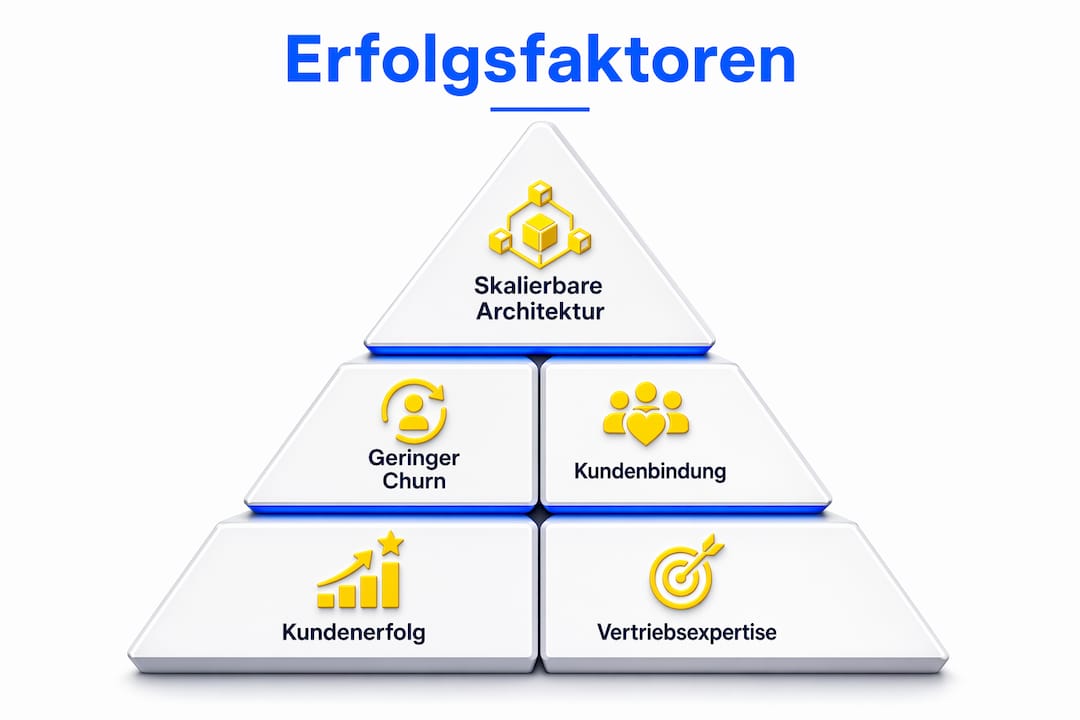
In this context, customer success isn't a cost center — it's a growth tool. Proactive engagement with existing customers leads to upgrades, renewals and referrals. That lowers CAC for new customers while raising net revenue retention.
Well-known examples and product categories
Real-world B2B SaaS examples help illustrate just how broad the space is. SaaS platforms like HubSpot offer modular CRM and marketing tools, while Trello supports project management through visual workflows. Both address different parts of B2B demand but follow the same core pattern: cloud-based access, subscription model, organic expansion via add-on modules.
The most common product categories in B2B SaaS:
- CRM and sales automation: customer relationship management, pipeline tracking and forecasting tools (e.g. HubSpot, Salesforce)
- Marketing automation: email campaigns, lead scoring and conversion tracking (e.g. Mailchimp, ActiveCampaign)
- Project management and collaboration: task management, Kanban boards and team communication (e.g. Trello, Asana)
- Accounting and finance: invoicing, tax reports and cashflow planning for SMBs
- HR and people operations: payroll, applicant tracking and onboarding processes
- Customer portals and internal tools: secure data rooms, admin panels and workflow-based process automation
What connects these categories: value comes not from the software itself but from being embedded in daily business processes. A tool employees use every day creates high switching costs and stable retention. For founders validating an idea, the question isn't just "who needs this?" but "who uses this daily and pays for it?"
The DACH region in particular is producing interesting niche products that international CRM giants don't cover well: industry-specific solutions for trades, tax advisors or logistics companies — privacy-aware, German-language, with local integrations built in. For founders with industry expertise, that's a structural advantage over generic platform solutions.
Pro tip: When testing new product features, roll them out systematically to small user cohorts before going broad. That reduces regression risk and protects customer satisfaction on critical workflows.
What I've learned from years in practice
I've worked with B2B SaaS founders at different stages, from the first product idea to scale-up with enterprise customers. What keeps surprising me: the technical challenges are rarely the real problem. The real problem is almost always fuzzy positioning, or a business model that calls itself SaaS but is actually project-based consulting with a software component.
My experience also shows that founder teams with sales experience often beat technically stronger competitors. Not because the product is better, but because they test real willingness to pay early, translate feedback directly into product decisions and build customer trust before competitors have even started the conversation.
What I've learned about the German market: data protection and compliance aren't bureaucratic hurdles, they're a real differentiator. A startup that can document privacy-aware architecture from day one improves its chances in healthcare, finance and public administration deals that often remain closed to purely engineering-led teams.
The myth that a good product sells itself is stubborn. The reality: in B2B, trust, demonstrable ROI and local presence matter more than feature lists.
— Anna
Building scalable B2B SaaS products with H-Studio Berlin
If you're building a B2B SaaS product that has to hold up in the German market, you need a technical foundation that matches the validated business model. H-Studio Berlin works with founders and growing teams to ship production-ready SaaS MVPs that account for data protection, operations and concrete enterprise requirements early.
From architecture through backend and database to deployment and post-launch support, H-Studio Berlin covers the full development cycle. Whether it's a custom platform, customer portal or admin panel with CRM integration, the work doesn't end at the first release. If you want to scope your project early, there's a structured tool for planning. Talk to the team before you make the technical decisions that get expensive later.
FAQ
What is a B2B SaaS startup?
A B2B SaaS startup is a company that sells cloud-based software on a subscription model to other businesses. The focus is on recurring revenue and improving organizational business processes.
How is B2B SaaS different from B2C SaaS?
B2B SaaS targets companies as customers, while B2C SaaS targets end consumers. B2B products have longer sales cycles, higher contract values and more complex integration and compliance requirements.
Which metrics matter most for B2B SaaS startups?
The key metrics include churn, MRR, gross margin, LTV, CAC and CAC payback. No thresholds are healthy for every segment; definitions, sales motion and contract value need to accompany any comparison.
What are typical B2B SaaS examples?
Typical B2B SaaS examples include HubSpot for CRM, Mailchimp for marketing automation and Trello for project management. These platforms solve specific business problems with cloud-based, modular products.
Why does GDPR matter for B2B SaaS startups in Germany?
If the product processes personal data, the applicable GDPR duties must be met. Enterprise buyers may additionally ask for evidence about data flows, processors, deletion and security; the exact requirements depend on the use case and procurement process.
Edited and fact-checked by Anna Hartung.