

Teams running a software platform and preparing for a regulatory audit usually hit the same wall: logs are incomplete, evidence is scattered, ownership is unclear. It's not that documentation was forgotten — it's that auditability was never embedded in the architecture. Designing an audit-ready architecture means treating traceability, integrity and evidence preservation as structural requirements from day one, not as an afterthought. This guide shows architects, developers and founders in the DACH region how to make it work in practice, from foundations through ongoing operations.
Key takeaways
| Point | Details |
|---|---|
| Auditability is architecture | Traceability has to be designed into the system from the start, not bolted on later. |
| Automatic evidence generation | Systems should produce data lineage, versioning and run evidence as part of normal operations, without relying on a separate documentation process alone. |
| Cover regulatory breadth | One unified architecture can support evidence needs for SOX, DORA, NIS2 and the EU AI Act in parallel and reduce duplicate work. |
| Continuous monitoring | Regular log validation and clear escalation paths are the foundation of sustainable auditability. |
| Early preparation pays off | Missing planning before implementation leads to expensive rework and higher audit risk. |
Foundations of audit-ready architectures
Auditability means the traceable and verifiable documentation of processes, data and controls in your organization, available at any time. Technically, that goes far beyond storing log files. A system is auditable when three core properties are supported end-to-end: traceability, immutability and integrity.
Traceability means every state change in the system is reconstructible — with timestamp, actor and context. Immutability ensures that stored logs cannot be deleted or altered after the fact. Integrity proves the data hasn't been tampered with, typically backed by cryptographic methods like hash chaining.
Integrity assurance via hash chaining and access control is central to audit-secure IT architecture, because it makes external tampering attempts provable. Without these mechanisms, you cannot show an auditor that logs are authentic.
The regulatory requirements for auditable systems are broader in 2026 than ever before. Relevant standards and laws in the DACH region include:
- ISO 27001 Annex A 8.15: log archives, retention periods, event completeness
- SOX (Sarbanes-Oxley Act): financial data traceability for publicly listed companies
- DORA (Digital Operational Resilience Act): IT resilience requirements for financial firms in the EU
- NIS2 Directive: reporting obligations and security requirements for critical infrastructure
- EU AI Act: transparency and evidence requirements for AI systems, especially in high-risk categories
Pro tip: Identify early which of these regulations apply to your product and industry. A fintech startup is subject to DORA and possibly SOX-style requirements from its investors at the same time, while a SaaS vendor in healthcare also has to meet sector-specific logging obligations.
That means the audit standards in architecture require you to define log types carefully: access logs, change logs, system events and business-process logs must be cleanly separated and managed with different retention periods.
Preparation: prerequisites before implementation
Before you build an audit-ready architecture, you need clarity on where you stand today. Without a complete inventory, no robust architecture decision is possible. Preparation has four essential steps:
- Inventory of data sources: capture every system, service and data flow that could produce audit-relevant events. That includes databases, APIs, authentication services and external integrations.
- Mapping regulatory obligations: tie each regulatory requirement to specific system components. Which data has to be stored, and for how long? Which actions need to be logged? Who owns it?
- Defining ownership: decide who is responsible for logging, validation and escalation. Without clear ownership, even well-planned systems decay over time.
- Choosing the right frameworks: pick tools that fit your infrastructure — for example Fluentd or OpenTelemetry for log aggregation, plus a SIEM (Security Information and Event Management) for centralized analysis.
The table below shows which technical and organizational prerequisites matter at different system sizes:
| System size | Technical requirement | Organizational measure |
|---|---|---|
| Startup MVP | Centralized logging, WORM-capable storage | Name a log owner inside the team |
| Growing SaaS | SIEM integration, structured log formats | Schedule regular log reviews |
| Enterprise platform | Layered architecture, regulatory view filters | Dedicated compliance team, escalation processes |
For founders, mapping regulatory obligations to system components is especially critical because it directly drives rework cost later. A privacy-aware data and log structure, like the one you should consider when building software with GDPR requirements in mind, can be made auditable with less extra effort in a well-prepared architecture.
Pro tip: Build a simple risk matrix: for each system component, note which regulations it touches and what the risk is if logging is missing. That makes it possible to prioritize before implementation starts.
Technical implementation and architecture principles
The most important principle is this: auditability is architecture, not documentation. Automatically generated, tamper-evident evidence has to be produced during normal operations — without developers or operators assembling data after the fact.
This approach can be called traceability by design: three core components are produced automatically while the system runs:
- Data lineage: the origin and transformation path of each data record, from source through current processing
- Versioning: a traceable history of every state of a data record or configuration item
- Run evidence: logged execution proofs for each process or workflow, with timestamp, input and result
Together, these three form what you might call an evidence pack that can support an audit review with less manual preparation.
For the technical implementation, a five-layer architecture has proven itself — source connector, aggregation, WORM storage, regulatory view filters and operational processes. Each layer has a well-defined job:
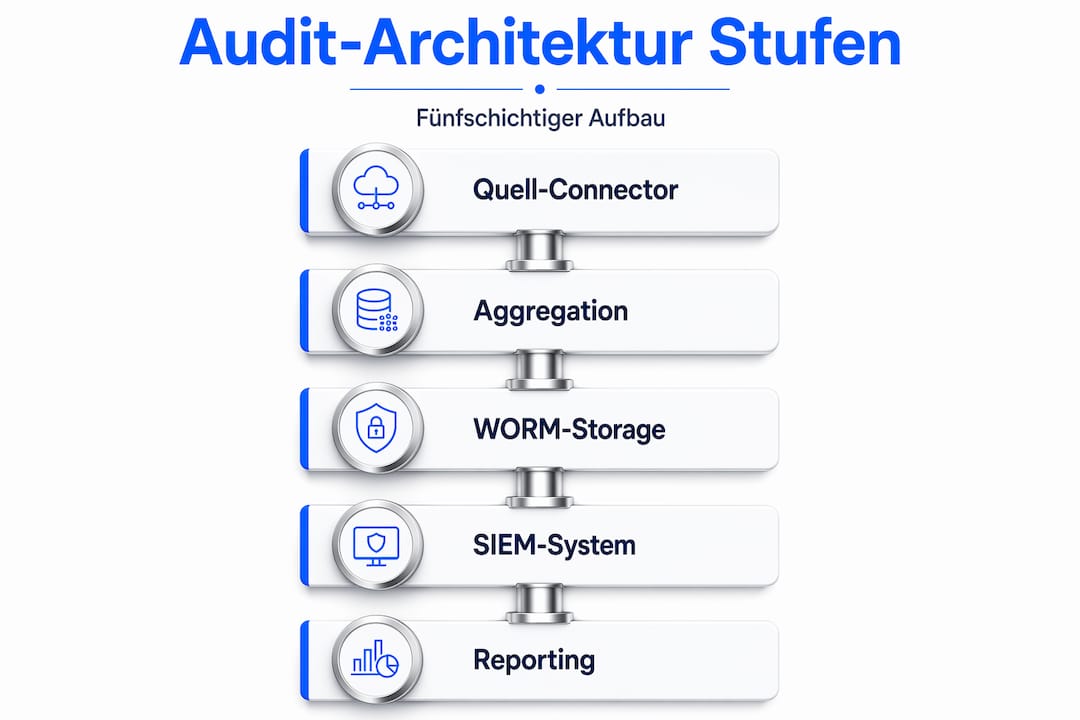
| Architecture layer | Function | Example technology |
|---|---|---|
| Source connector | Capture events from source systems | Kafka Connect, Debezium |
| Aggregation layer | Normalize and merge logs | Fluentd, Logstash, OpenTelemetry |
| WORM storage | Immutable storage for logs | AWS S3 Object Lock, Azure Immutable Blob |
| View filters | Regulatory views per requirement | Custom query layer, SIEM rules |
| Operational processes | Monitoring, escalation, reporting | Grafana, PagerDuty, SIEM dashboards |
The advantage is that this architecture can support SOX, DORA, NIS2 and EU AI Act evidence needs with one coherent technical implementation. Instead of building a dedicated logging stack per regulation, the central data layer feeds relevant evidence through tailored view filters.
WORM storage (Write Once, Read Many) is not optional. Only immutable storage protects log data against tampering after the fact, whether through internal error or external attack. For cloud-native systems, AWS S3 Object Lock and Azure Immutable Blob Storage provide ready-made WORM implementations that integrate cleanly with existing architectures.
One caveat that matters in the EU: immutability collides with the GDPR right to erasure. Don't write personal data into immutable logs. Either keep personal data out of the WORM layer entirely, or design for crypto-shredding and forgettable payloads — store a reference or an encrypted blob whose key can be destroyed — so you can honour an erasure request without breaking the integrity guarantee on the rest of the chain. For the full treatment of this erasure trap — plus the Data Vault model and the cost trade-offs — see the companion piece on auditable architecture: benefits and practice.

Another important feature of auditable architectures is SIEM integration. A SIEM correlates events from multiple sources in real time, detects anomalies and generates alerts automatically. For financial firms under DORA, continuous monitoring and prompt detection of anomalies are regulatory requirements — and in practice that pushes most teams toward a SIEM, even though the regulation is technology-neutral and doesn't prescribe one as such.
Pro tip: Pick structured log formats like JSON with a fixed schema from day one. Unstructured free-text logs are hard to analyze machine-readable later and inflate audit-preparation cost significantly.
The link between scalable software architecture and auditability is direct: a system that stays stable as data volume grows also has to scale its log infrastructure. Log volumes in active products can quickly grow into terabyte territory. If you don't plan for that, the first audit becomes a capacity problem.
Operating and governing audit-ready systems
A well-designed architecture is only as good as how you maintain it. Continuous audit monitoring and clearly defined escalation processes are non-negotiable for sustainable auditability. Without regular validation, even the best system degrades over time.
The governance of an audit-ready system breaks into five operational areas:
- Roles and responsibilities: name a log owner per system area. In larger teams, a dedicated compliance or security team coordinates. Responsibilities have to be documented in writing and reviewed regularly.
- Regular validation: check at least monthly whether every defined event type is actually being logged. Failures in the log pipeline — a dead connector, a buffer running full — often go unnoticed for weeks without active monitoring.
- Alerting and escalation: configure automatic alerts for critical events: gaps in the log chain, unusual access patterns, storage failures. Define clear escalation paths so alarms don't disappear into someone's inbox.
- Audit prep through reporting: produce regular reports that summarize the state of logging. These reports serve both as evidence to auditors and as internal quality assurance.
- Improvement loops: every external or internal audit should feed into a structured review. Findings go into a backlog, get prioritized and are resolved in the next iteration.
ISO 27001 Annex A 8.15 focuses on logging and monitoring controls. Retention periods, event coverage and ownership should be clearly defined and reviewed regularly. This isn't a one-off project — it's an ongoing operational process.
For growing companies, a log-health dashboard is worth introducing — one that shows in real time which sources are actively logging, where gaps appear, and whether retention periods are being met. Tools like Grafana on top of a Loki or Elasticsearch backend make this possible without disproportionate effort.
Pro tip: Treat your logging infrastructure like production code: with versioning, tests and deployment processes. A bug in the logging pipeline that goes unnoticed can make an entire audit window unusable.
What I've learned about audit practice in the real world
In recent years I've watched a lot of teams hit panic mode just before an audit because their logs were incomplete or couldn't be shown to be intact. The frustrating part is that the problem almost always looks the same: somewhere early in the project, someone decided to add auditability later. Later never comes.
Here's what I've learned: the audit trap isn't created by bad intent — it's the understandable urge to ship features first and push compliance topics off. That's fine during MVP work, but it gets expensive the moment the first external audit lands.
In my experience, the bigger problem isn't missing documentation — it's the lack of automatic evidence generation. Systems that don't produce data lineage, versioning and run evidence on their own force teams to assemble proof manually before each audit. That's error-prone, time-consuming, and rarely holds up in front of an experienced auditor.
My pragmatic advice: start small, but start now. A single immutable log table with a structured schema is better than ten badly implemented logging solutions. Grow from there systematically, layer by layer.
— Anna
Building audit-ready architecture with H-Studio
If you want to do more than understand audit-ready architecture — if you want to actually ship it — you need a partner who knows both the regulatory requirements and the technical implications. H-Studio builds scalable software architectures for founders, startups and growing companies in the DACH region, with a clear focus on auditability, privacy requirements and production-ready implementation.
Whether it's a SaaS MVP, an enterprise platform or an internal tool, we'll work with you from the architecture decision through ongoing governance. Our engineering services cover the whole stack, from the logging infrastructure to SIEM reporting. If you need a solid foundation for your compliance setup fast, book a 5-day Architecture Sprint as the entry point; for ongoing operations, our team helps with DevOps and cloud engineering. Get in touch and discuss your project with an experienced architecture partner.
FAQ
What is an audit-ready architecture?
An audit-ready architecture is a software design that structurally supports the traceability, immutability and integrity of system events. Logs are produced automatically according to defined coverage, with tamper-evident controls where the risk profile requires them.
Why are auditable systems relevant for startups?
Why auditable systems matter even in early product stages: regulatory requirements like GDPR, DORA or ISO 27001 apply regardless of company size. Teams that don't build in auditability from day one pay heavy rework cost later.
What are the characteristics of audit-ready architectures?
The hallmarks of audit-ready architectures are: structured, immutable log storage (WORM); automatic generation of data lineage and run evidence; clear ownership; and regulatory view filters for different compliance needs.
How does traceability by design differ from classic logging?
Classic logging stores events reactively and often unstructured. Traceability by design means the system produces evidence automatically as part of normal operations — including origin, versioning and execution proof — without manual cleanup.
Which regulations require an audit-ready architecture?
ISO 27001, SOX, DORA, NIS2 and the EU AI Act each impose specific requirements on logging and verifiability. One unified architecture can support evidence for several of them with a coherent technical implementation, reducing redundant infrastructure.
Edited and fact-checked by Anna Hartung.