

The role of architecture in B2B SaaS only gets taken seriously by many teams once systems collapse under load or a compliance audit raises uncomfortable questions. Yet architecture decides whether the product scales long before a hundred customers — systems can hit limits at just a few dozen accounts when the foundation is missing. This guide focuses on the decisions that actually matter and, crucially, the implementation details that bite later.
Key Takeaways
| Point | Details |
|---|---|
| Architecture as foundation | Early decisions determine scalability, compliance and operating cost across the lifecycle. |
| Tenancy model | Shared Schema, Schema-per-Tenant and Database-per-Tenant trade isolation against cost and complexity. |
| Compliance from day one | Privacy-aware data isolation and auditing are core architecture, not a late add-on. |
| Automation reduces risk | Without automated provisioning, operational effort grows steeply with each tenant. |
| Hybrid models in practice | Many B2B products mix tenancy models by customer size and requirement. |
Why architecture is different in B2B
SaaS architecture is the set of structural decisions about how data is stored, how tenants are isolated, how services communicate and how the system behaves under load — the foundation every feature, integration and customer agreement sits on.
In B2B, this challenge differs fundamentally from consumer software. Enterprise customers bring their own compliance requirements, SLA expectations and integration needs. A flaw in tenancy design is not a bug in B2B. It is a potential data-protection problem that puts contracts at risk.
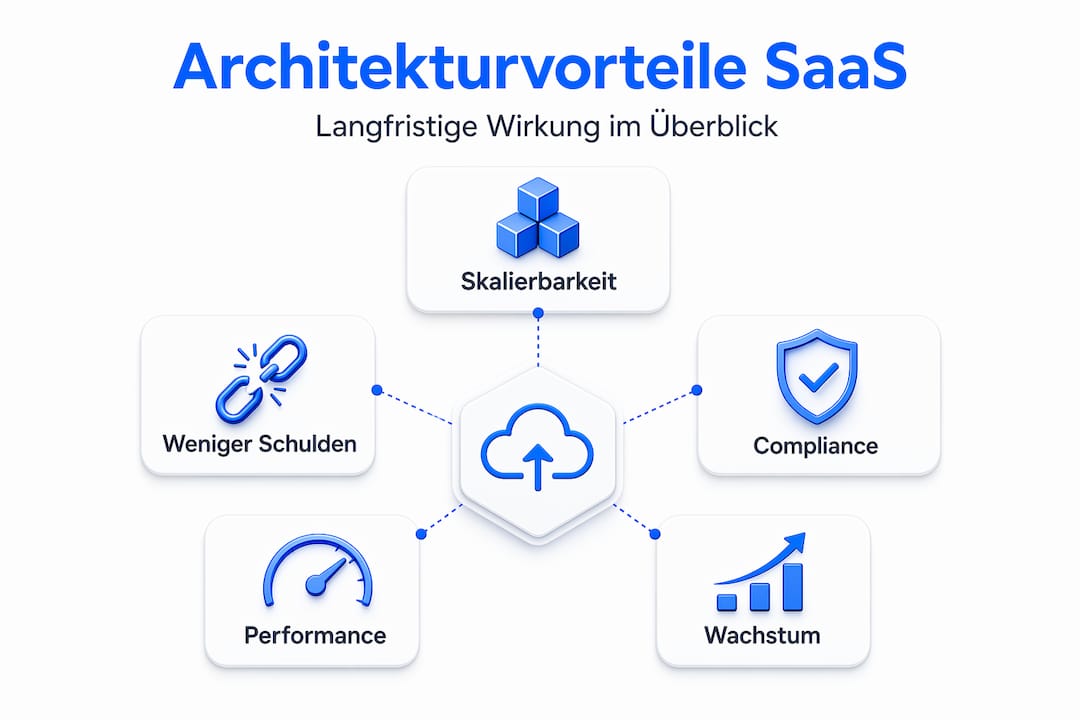
It shows up in five concrete areas:
- Scalability: Poorly structured systems rarely grow horizontally without expensive rewrites.
- Security and compliance: GDPR, ISO 27001 and sector rules demand architectural controls, not patchwork fixes.
- Operating cost: Inefficient database structures and missing resource isolation translate directly into higher cloud bills.
- Customer retention: Enterprise buyers review architecture during due diligence. Bad design costs contracts.
- Development velocity: Clean architecture means new features can ship without regression risk.
Early architecture work can reduce later technical debt substantially. Teams that ignore it often pay later in months of refactoring effort.
Tenancy models: the implementation trade-offs
Tenant isolation is the central B2B SaaS concept, and three models dominate. For the full model-selection framework — which model fits which risk class, plus the DACH go-to-market angle — see Scalable SaaS architecture: why DACH startups must plan earlier. This article focuses on what each model costs you to build and run.
Shared Schema stores all tenant data in the same tables, distinguished by a TenantId column. It has the lowest infrastructure cost but demands strict Row-Level Security (RLS) on every database access, plus high discipline in application queries: one missing filter can become a cross-tenant leak.
Schema-per-Tenant gives each tenant its own schema in the same database instance — better isolation than Shared Schema, but migrations have to run per schema, raising operational overhead.
Database-per-Tenant isolates fully: a database instance per tenant. Strongly regulated or security-sensitive customers often require this level of isolation, though it is not universal; plenty of regulated SaaS products run shared models with rigorous RLS instead. The cost is higher but can be controlled with Azure Elastic Pools or equivalent pooling on other clouds.

| Model | Isolation | Cost | Complexity | Suited for |
|---|---|---|---|---|
| Shared Schema | Low | Very low | Low | Startups, small customers |
| Schema-per-Tenant | Medium | Medium | Medium | Growing teams |
| Database-per-Tenant | High | High (optimisable) | High | Enterprise, regulated industries |
Hybrid models combine Shared Schema for small customers with Database-per-Tenant for enterprise accounts. This is sustainable in practice because it addresses cost and compliance requirements at the same time. The technical challenge is a routing layer that lets tenants migrate transparently between models.
Pro tip: Don't decide the tenancy model solely by your current customer profile. Analyse which customer segments you want to address in 18 to 24 months and plan the migration path from the start.
Implementation and performance: where it actually breaks
The model is the easy part; the implementation details are what cause incidents.
- Build observability in from the start. Latency, traffic, errors and saturation — the four golden signals — let you make architecture decisions on data, not guesswork. More on the operational layer in SaaS scaling: architecture, growth and best practices.
- Design tenant resolution efficiently. Every API request must resolve the correct tenant. That can happen via subdomain, header or JWT claim. A poorly designed resolution layer becomes a bottleneck at high traffic.
- Avoid EF Core query-filter cache poisoning. In Entity Framework Core, multi-tenant global query filters must capture the tenant value dynamically. If the filter is baked into a compiled query shape, query caching can turn into a data-isolation bug. The same class of footgun exists in any ORM with cached compiled queries.
- Use Elastic Pools or equivalents for cost control. They share resources across many tenant databases and smooth peak load without dedicating capacity to every tenant.
- Manage noisy-neighbor problems actively. When a single tenant impacts the performance of other customers through intensive queries, that's an architecture problem. Tenant-level throttling and separated resource pools are the countermeasures.
- Structure API layers cleanly. A scalable API architecture cleanly separates authentication, authorisation and business logic. That makes both scaling and later auditing easier.
Pro tip: Implement tenant throttling as early as the MVP. Adding it later, with a growing customer base, is expensive and risks production outages during migration.
Compliance and data protection through architecture
Enterprise customers in DACH expect documented, privacy-aware data flows, clear data residency and provable audit trails — common prerequisites for moving a contract forward, not optional procurement topics.
A strong approach to data isolation and auditability supports enterprise customer acceptance. Architectural measures that concretely help:
- Row-Level Security (RLS) at the database layer as a second line of defence behind application logic.
- Per-tenant backup and restore, so customer-specific export and deletion requests can be handled without touching other tenants.
- Database instances in defined geographic regions for customers with data residency requirements — particularly relevant for public-sector buyers and financial services.
- Tenant-level audit logs that make it traceable who accessed which data and when. See auditable architecture, including the right-to-erasure caveat for immutable logs.
- Automated compliance tests in the CI/CD pipeline that help catch isolation gaps before deployment.
Tenancy isolation should be treated as core architecture and planned from the start, not as a late add-on. Teams that treat compliance as a feature to be added later significantly underestimate the structural effort. Retrofitting stronger tenant isolation into a running SaaS system usually means a partial rewrite of the data access layer, costing weeks to months.
For product managers that means: compliance requirements belong in the initial architecture roadmap before the first production customer is onboarded. Broader data-protection guidance is covered in GDPR-compliant software.
From architecture to scaling strategy
Best practices for B2B SaaS architecture don't end with technical design. Leaders and product managers must understand how architecture connects to product growth. Here are the steps that make the difference:
- Make architecture decisions in Sprint Zero. The tenancy model, database strategy and observability framework belong in the very first planning phase. Adding identity, billing and observability components later often leads to massive cost and project delays.
- Prioritise configuration over custom code. Flexible design prevents the emergence of many custom forks per customer. Every customer-specific tweak that ends up as a separate code branch is technical debt with compound interest.
- Automate provisioning from the start. Without automation, operational effort climbs steeply with tenant count. A new customer account should be triggered via API and fully provisioned without manual steps.
- Integrate architecture reviews into the product cycle. Not just at launch, but at every significant feature milestone, architecture should be reviewed for scalability and security. That prevents technical debt accumulating invisibly.
- Define clear handoff protocols between architecture and product teams. B2B architecture strategies only work when product managers understand the consequences of feature decisions on system structure. Regular technical reviews at leadership level are the most effective instrument.
Planning the architecture of scalable backend systems doesn't mean solving every problem in advance. It means creating the structures that enable growth without destabilising the system.
My take: architecture as a strategic advantage
Over the past years I've seen many SaaS projects fail the same way. The team builds fast, early customers are enthusiastic, and then the system starts to wobble at fifteen or twenty enterprise accounts. Database queries slow down, onboarding processes go manual, and the first compliance audit reveals gaps nobody had planned for.
What surprises me again and again: most of these problems were architecturally avoidable. Not with huge effort, but with the decision to ask the right questions early.
My experience is that teams often perceive architecture as a brake. "Let's build fast now and refactor later." That sentence has cost more products than any other technical bad call. Refactoring multi-tenant isolation in a running system is rarely "later". It's a crisis moment.
What I've learned: the best architecture isn't the technically most elaborate. It's the one the team understands, that carries the product and doesn't block growth. Early investment in modularity, clear tenancy boundaries and observability pays off long before you see the dividend.
My advice to product managers and leaders: don't treat architecture as a purely technical topic. It is a competitive advantage through architecture that shows up in lower operating cost, faster feature cycles and won enterprise contracts. The question isn't whether you invest in architecture. The question is when.
— Anna
H-Studio Berlin as architecture partner for B2B SaaS
Building or scaling a B2B SaaS product takes more than a developer. It takes a partner that connects architecture decisions to product growth.
H-Studio Berlin is an architecture-first software studio in Berlin focused on production-ready SaaS for founders and growing companies in DACH — from architecture strategy through backend development and tenant isolation to GDPR-aware deployment planning. To structure your requirements, our Architecture Sprint is a quick entry into scope and resource planning. Talk to the team before technical debt becomes a strategic burden.
FAQ
What does software architecture mean in a SaaS context?
Software architecture in a SaaS context refers to the structural decisions about data storage, tenant isolation, service communication and scaling behaviour. It determines how the system reacts under load and whether compliance requirements can be met.
Which tenancy model is best for B2B SaaS?
It depends on customer size and compliance needs. Database-per-Tenant offers the strongest isolation for regulated enterprise customers; Shared Schema is more cost-efficient for smaller ones. Many products combine both.
How does architecture influence GDPR compliance?
Architecture determines whether data isolation, per-tenant deletion and audit trails are technically feasible. Without the right structural foundations, GDPR requirements are much harder to implement reliably, regardless of legal or process measures.
When should architecture decisions be made?
As early as possible — ideally before the first production code. Retrofitting tenant isolation, observability and billing regularly causes major delays and extra cost.
What is the noisy-neighbor effect and how do you prevent it?
The noisy-neighbor effect describes how a resource-intensive tenant degrades the performance of other customers in shared infrastructure. Tenant-specific throttling and separated resource pools at the infrastructure layer are the most effective countermeasures.
Recommended reading
- Scalable SaaS architecture: why DACH startups must plan earlier — the tenancy-model selection framework
- Secure architecture for SaaS: the founder's guide — RLS and access control in depth
- SaaS scaling: architecture, growth and best practices — the operational layer
- Scalable software architecture: benefits for founders & CTOs — the model decision
Edited and fact-checked by Anna Hartung