


Many founders and CTOs treat scalability as tomorrow's problem. That's an expensive mistake. Launching an MVP without a deliberate architecture risks a full rewrite 12 to 18 months later — one that often costs more than the original build. In DACH, GDPR requirements and high enterprise expectations sharpen that risk further. This article shows which architectural decisions actually matter, which tools make the difference, and how to avoid the rewrite trap from day one.
Table of Contents
- Foundations of SaaS Scalability
- MVP Architecture Decisions: Monolith, Modularity, or Microservices?
- Practical Tools and Infrastructure
- DACH Specifics: Multi-Tenancy, Compliance, Cloud Choice
- Practical Roadmap: from MVP to a Successful SaaS Product
- Architecture Decisions in the Wild: What Practice Shows
- Scalable SaaS Solutions, Implemented by Experts
- Frequently Asked Questions
- Key Takeaways
Key Takeaways
| Point | Detail |
|---|---|
| Early architecture pays off at scale | Deliberate architecture from day one saves expensive restructuring later. |
| Modular monolith as a bridge | Combines fast MVP delivery with the flexibility to extract modules later. |
| Core tools automate scaling | Docker, Kubernetes, CI/CD and read replicas keep performance steady as usage grows. |
| Don't underestimate DACH compliance | GDPR and hyperscaler choice aren't late decisions — they shape the architecture from sprint one. |
Foundations of SaaS Scalability
In a SaaS context, scalability is more than "add more servers." It's a system's ability to stay stable under growing load — without costs scaling proportionally or the architecture needing a fundamental rebuild.
Three dimensions decide it:
- Load distribution: Requests are spread intelligently across available resources, without overloading individual components.
- Cost control: Resources are provisioned on demand. Idle capacity costs money startups don't have.
- Compliance capability: Especially in DACH, privacy requirements have to be considered from the first sprint. Retrofitting is expensive and error-prone.
A structured look at the foundations of SaaS architecture before the first line of code is written is not a luxury — it is the precondition for sustainable growth.
Typical load spikes come from unexpected usage patterns. A B2B SaaS product designed for 50 concurrent users can suddenly face 5,000 requests per minute during an enterprise integration. Without prepared infrastructure, the system collapses.
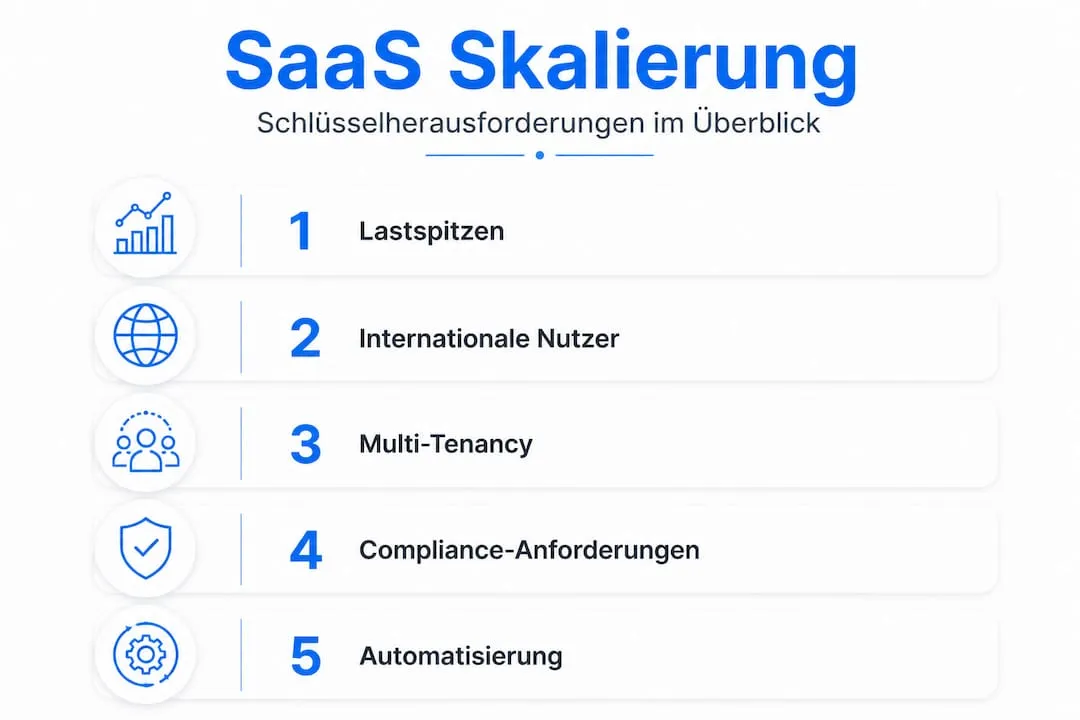
For the DACH market there's an extra dimension: SaaS internationalisation requires not just language adaptation but technical flexibility around data residency and hosting locations. Building on cloud-native tools like Docker and Kubernetes from day one creates the foundation for that flexibility.
MVP Architecture Decisions: Monolith, Modularity, or Microservices?
Architecture is the first major decision for any SaaS product, and most teams make one of two classic mistakes: an unstructured monolith that becomes unmaintainable, or microservices straight out of the gate, drowning in operational complexity.
| Architecture | Strengths | Drawbacks | Recommendation |
|---|---|---|---|
| Monolith | Fast development, simple deployment | Hard to scale, high coupling | Only for early prototypes |
| Modular monolith | Fast like a monolith, structured like microservices | Requires discipline on module boundaries | Ideal for MVPs through Series A |
| Microservices | High scalability, independent deployments | High complexity, expensive to operate | Typically past ~20 engineers / ~€5M ARR |
The modular monolith is the smartest choice for most B2B SaaS startups: fast delivery like a classic monolith, but with clean module boundaries that make a later migration to microservices far easier.
Premature optimisation is the biggest risk. Teams that move to microservices too early fight distributed transactions, service discovery, and elevated monitoring overhead — before they've even found product–market fit. That costs time and capital.
"Below roughly €5M ARR and 20 engineers, a well-structured monolith almost always wins. Microservices are first an organisational decision (team boundaries), and only then a technical one."
Pro tip: Define module boundaries along business domains, not technical layers. A "Billing" module beats a "Repository" layer, and makes later extraction as a standalone service much easier. We compare concrete stack choices in our Modern Web Stack overview.
Practical Tools and Infrastructure for Scalable SaaS Products
Today's cloud ecosystem makes professional infrastructure accessible to small teams. The most important building blocks:
- Docker: Containerisation produces consistent environments across dev, staging, and production. No more "works on my machine."
- Kubernetes: Container orchestration, automatic restart on failure, rolling deployments without downtime.
- CI/CD (GitHub Actions or GitLab CI): Automated tests and deployments reduce human error and shorten release cycles.
- Redis as a cache layer: Cuts repeated database queries and improves response times under load.
- Read replicas: Usually the first step before database sharding: they offload read traffic from the primary so it can keep serving writes. How much they help depends entirely on your read/write ratio — read-heavy workloads benefit most, write-heavy ones barely at all.
| Tool | Purpose | When to introduce |
|---|---|---|
| Docker | Containerisation | From day one |
| Kubernetes | Orchestration | From a stable MVP onwards |
| Redis | Caching | Around the first read-heavy load (~500 concurrent users) |
| Read replicas | Read load distribution | Before the first read bottleneck |
| GitHub Actions | CI/CD | From the first sprint |
Pro tip: Start with cloud-native SaaS services on managed Kubernetes (GKE, EKS, AKS). Self-hosted Kubernetes burns disproportionate operational effort for a small team; managed services remove infrastructure maintenance so you can focus on the product.
As a rough guideline, turn on auto-scaling once utilisation regularly sits above ~70% of available CPU; below that, manual sizing is often cheaper and more predictable. The same "measure first, scale second" principle applies to analytics and ETL pipelines as data volumes grow.
DACH Specifics: Multi-Tenancy, Compliance and Cloud Choice
Technical foundations alone aren't enough — regional and compliance requirements play a critical role in DACH.

Choosing the hyperscaler isn't a purely technical decision. AWS, Azure, and GCP in the DACH context differ not just on price and features but on compliance certifications and the availability of German data centres. For FinTech and Legal-Tech startups, that choice can decide whether deals close.
Key DACH infrastructure decisions:
- Hyperscaler choice: AWS Frankfurt, Azure Germany North, and GCP Frankfurt all offer EU-region, GDPR-aligned hosting. Azure often carries a trust advantage with DACH enterprises through existing Microsoft relationships. One nuance worth stating honestly: an EU region on a US hyperscaler still sits under a US parent company and the US CLOUD Act — which is exactly why some DACH enterprises and public-sector buyers push toward EU-sovereign or German-operated providers.
- Multi-tenancy model: Pool (shared database with tenant ID) or silo (separate instance per customer); the choice depends on security requirements and customer profile.
- Privacy-aware data flows: Data must not unintentionally cross into third countries. Logging, monitoring, and analytics tools all need reviewing for where they send data.
- Audit trails: DACH enterprise customers expect complete traceability of data access.
Critical mistake in tenant isolation: Many teams implement the pool model without consistent row-level security (and without forcing it for the application's DB role — a frequent Postgres footgun). A single faulty query then returns data from every tenant. That's not just a security problem; it's a GDPR violation with significant fine exposure.
The silo model offers stronger isolation but costs more to operate — a fit for enterprise customers with high compliance requirements. The pool model fits SMB customers where cost efficiency takes priority. Many successful DACH SaaS products run both in parallel, split by customer segment. More perspectives on compliance and multi-tenancy in SaaS in our practice notes.
Practical Roadmap: from MVP to a Successful SaaS Product
This roadmap reflects the resources and priorities of typical seed- to Series-A startups:
- Phase 1 (months 1–3): lay the foundation. Modular monolith with clean domain boundaries, Docker containerisation, CI/CD from sprint one, basic monitoring with Prometheus and Grafana.
- Phase 2 (months 4–8): stabilise and observe. Read replicas, Redis caching for frequent queries, alerting on critical metrics, an active tech-debt backlog.
- Phase 3 (months 9–15): scale on demand. Auto-scaling above ~70% CPU, extract the first modules as standalone services where needed, migrate to Kubernetes if not done yet.
- Phase 4 (from month 16): structure growth. Team growth along domain teams, clear service ownership, defined and measured SLOs.
Pro tip: Keep an Architecture Decision Record (ADR) from day one. Every important decision documented with context, alternatives, and rationale — as the team grows, this saves significant time and stops new engineers from rerunning the same debates.
Tech debt isn't a sign of weakness; it's a sign of conscious decisions. It becomes a problem only when it grows undocumented and uncontrolled. Plan at least ~20% capacity per sprint for refactoring and infrastructure work. Our project planner for SaaS scaling helps structure a concrete timeline.
Architecture Decisions in the Wild: What Practice Shows
Beyond theory and best practices, the honest answer is: less complexity wins almost every time.
Microservices get sold as the modern standard at conferences and by consultancies. In practice, we regularly see early-stage teams spending more time on infrastructure problems than on the product. Distributed transactions, eventual consistency, and service-mesh configuration are real complexity drivers that overwhelm a small team fast.
The modular monolith is the most underestimated architecture for the SaaS MVP context. It enables development speed but enforces structural thinking. Teams that draw clean domain boundaries from day one can later extract individual modules into services with manageable effort. That's not a compromise — it's the right sequence.
Another blind spot: monitoring keeps getting deferred as "we'll do that later." Without observability you don't know where the system actually struggles under load — and no monitoring means acting blind in a crisis. Start with basic monitoring in sprint one, not sprint ten.
The uncomfortable truth for many CTOs: most scaling problems aren't caused by missing technology, but by missing structure. Clean module boundaries, documented decisions, and consistent coding standards prevent more rewrites than any cloud tool. Teams that invest early in structure scale later with far less friction.
Scalable SaaS Solutions, Implemented by Experts
H-Studio works with B2B SaaS startups across DACH from the first architectural decision through to production-ready scaling.
With the Architecture Sprint (5 days, €3,500), founder teams get structured architectural guidance before the first line of code — preventing expensive direction changes. For teams already in development, our MVP-to-Production engagement is the direct path to an architecture that holds up through seed and Series A. Use the project planner to estimate concrete need, or explore our engineering services for SaaS teams directly. We don't sell hours — we sell structural certainty.
Frequently Asked Questions on SaaS Scalability
What is a modular monolith and why is it the right fit for SaaS MVPs?
A modular monolith is a single deployable with clearly separated, domain-oriented modules. It offers the development speed of a classic monolith while enforcing the structural discipline that makes later modularisation into microservices much easier.
When does auto-scaling start paying off in SaaS?
As a rough guideline, once utilisation regularly exceeds ~70% of CPU capacity. Below that, manual sizing is often more cost-efficient.
Which tools are recommended for scalable SaaS MVPs in DACH?
Docker for containerisation, Kubernetes for orchestration, CI/CD with GitHub Actions, Redis for caching, and read replicas to offload read traffic (how much they help depends on your read/write ratio).
How do multi-tenant models differ in the DACH SaaS market?
Pool models share a database (distinguished by tenant ID); silo models give each customer a separate instance. The choice depends on the security and compliance requirements of the specific customer segment.
Read more
This article maps the broad architectural strategy for SaaS founders in DACH. The matching service tracks:
- SaaS MVP Development · Berlin — the geo-targeted track that translates this strategy into concrete engagement shapes (Architecture Sprint, MVP Foundation, Engineering Partnership)
- Architecture Sprint · 5 days, €3,500 — fixed-scope strategic architecture review
- SaaS in B2B: Architecture, Scaling and Compliance — broader B2B context
- Evolutionary Architectures: How B2B SaaS Reduces Rewrite Risk — the rewrite-risk strategy this article cross-references
- Scalable Backend Systems for SaaS Growth — the backend deep dive
- Business Technologies 2026: 5 Trends for Training & Learning — Amlogy AR/VR
Edited and fact-checked by Anna Hartung.