H-Studio logo
Start a project

CRM integration and lead routing for B2B sales teams

We connect website enquiries, CRM stages, owner assignment, follow-up workflows and pipeline reporting into one maintainable sales system — with custom integration logic where standard automation tools no longer fit the process.

Scope of this page

From enquiry to owned sales follow-up

This page covers the system after a lead enters your sales process: CRM structure, routing, lifecycle stages, owner assignment, follow-up workflows, source handling, reporting and migration. For the website, landing pages and SEO architecture that generate enquiries, see Lead Generation Websites. For a custom operational interface beyond the CRM itself, see Internal Tools.

The problem

What breaks when lead flow grows without a clear CRM system

  1. 01Enquiries arrive, but ownership is unclear
    Forms create contacts or emails, but assignment, qualification and next actions still depend on manual handling.
  2. 02Source data becomes unreliable
    Campaign, page and referral information is missing, inconsistent or separated from the opportunity that sales actually works on.
  3. 03Automations grow into fragile chains
    Small changes to forms, fields or pipeline stages break follow-up rules and reporting because no one owns the full flow.
  4. 04Reporting does not match sales reality
    Marketing sees submissions, sales sees deals, and management cannot reliably connect enquiries to pipeline outcomes.
01  ·  What we deliver

What we deliver

01

CRM structure and lifecycle model

Pipeline stages, lead and opportunity states, custom fields, ownership rules and qualification logic aligned with the real sales process · Consent and data-handling fields mapped where relevant · Documentation for the team managing the CRM
02

Lead routing and workflow automation

Assignment by service, region, language, source, priority or account responsibility · Deal creation and stage-triggered actions · Validation and duplicate-handling rules · Follow-up tasks and internal notifications based on meaningful CRM events

03

Website-to-CRM handoff

Integration of existing or newly built enquiry forms with HubSpot, Pipedrive, Salesforce, Microsoft Dynamics 365 or suitable existing CRM systems · API or webhook-based submission handling · Qualification fields and source information passed into the CRM where the technical and consent setup supports it

04

Pipeline visibility and reporting

Lead-source structure · Funnel views by meaningful lifecycle stage · Enquiry, qualification and opportunity reporting · Reporting configuration inside the CRM or connected dashboards where built-in reporting is insufficient

05

Migration, cleanup and handover

Field mapping, duplicate cleanup and pipeline reconstruction · Migration testing before cut-over · Existing automation review · Documentation of workflows, integrations and ownership · Handover so the sales or operations team is not dependent on undocumented automation

Stack

Typical CRM integration foundation

CRM platforms
  • HubSpot
  • Pipedrive
  • Salesforce
  • Microsoft Dynamics 365
  • Existing or less common CRM systems where stable API access and ownership are available
Integration layer
  • Native CRM workflows
  • Automation tools where maintainable
  • Custom API or middleware logic where business rules or reliability requirements justify it
Lead data and reporting
  • Website enquiry handoff
  • Source and campaign fields where appropriate
  • CRM-stage reporting
  • Analytics connections aligned with consent requirements
Delivery and handover
  • Integration documentation
  • Field mapping
  • Workflow rules
  • Access ownership
  • Testing before release or migration
When it fits

When this service fits

This service fits when:

  • Website enquiries are not reaching the right CRM stage, owner or follow-up process
  • Sales teams manually copy, qualify or assign leads across tools
  • Source information and pipeline outcomes cannot be connected reliably enough for decisions
  • Existing automations are fragile, undocumented or difficult to change
  • You need to migrate, clean up or restructure an existing sales CRM
  • You want sales processes documented clearly enough for the team to maintain after handover
Attribution

Attribution without pretending the data is perfect

Privacy controls, consent choices, browser restrictions and incomplete source data mean that no B2B attribution setup captures every interaction reliably. We design CRM source handling around what can be recorded responsibly at enquiry stage and reported transparently afterwards.

  • Source and campaign information captured at enquiry submission where available and appropriate.
  • CRM-native fields structured so sales outcomes can be compared with known lead sources.
  • Consent-aware analytics and tag behaviour configured around the selected setup.
  • Server-side event handling considered only where it improves reliability and fits the data-handling requirements.
  • Reporting makes missing or unknown attribution visible rather than presenting inferred certainty as fact.
Selected CRM and revenue-operations work

Where CRM is the source of truth, not a side system

A revenue-operations build where CRM structure, routing and reporting shaped the architecture.

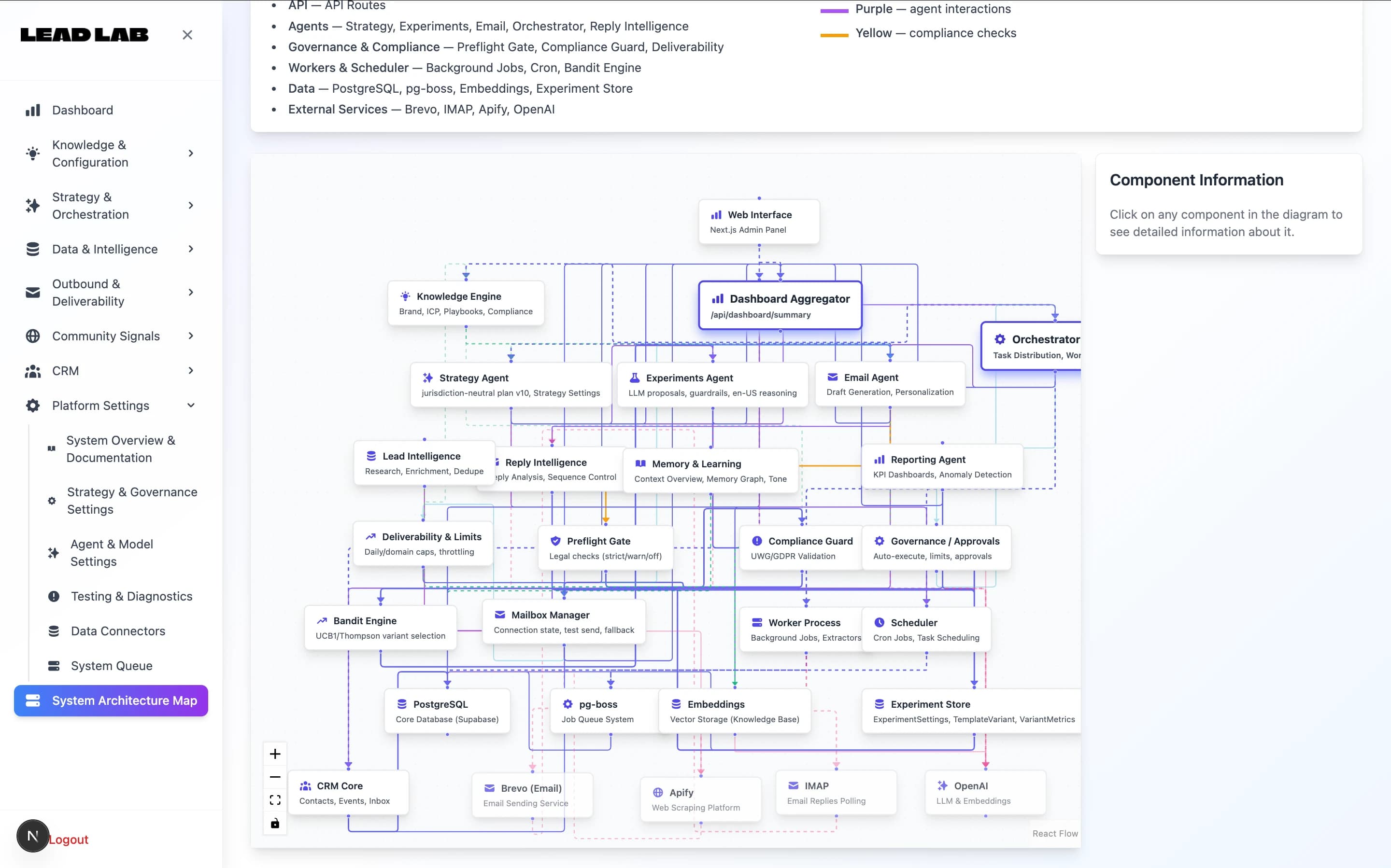
Lead Lab  -  B2B Revenue Operations Platform with Automation & Intelligence FeaturesStartup Engineering

Lead Lab - B2B Revenue Operations Platform with Automation & Intelligence Features

  • Starting point

    Revenue operations relied on multiple disconnected data sources and manual reporting, making lead ownership and pipeline visibility difficult to maintain.

  • What we did

    Built a revenue operations platform around structured lead flows, routing logic, reporting and selected assisted analysis features under human review.

  • Outcome

    Operational reporting and lead handling were consolidated into one controlled workflow.

Read full case
FAQ

FAQ

  1. We most often work with HubSpot, Pipedrive, Salesforce and Microsoft Dynamics 365. Existing or less common CRM systems can be assessed where stable API access and ownership are available. The first step is always to define the pipeline, fields, ownership and lead flow before automation is added.

  2. Yes. Enquiry forms map to CRM stages, owners, source fields and qualification fields explicitly — different form, page or source can route the lead into a different pipeline, stage or owner. We design the routing logic alongside the handoff, not after.

  3. Yes — that is the default. Your CRM stays the system of record; we review the current setup, fix broken stages, weak routing, poor source tracking and manual workarounds, then rebuild automation around the real sales process. Replacing the CRM is a separate, much heavier evaluation we only recommend when the platform genuinely cannot model the business.

  4. Yes. Field mapping, pipeline reconstruction, duplicate cleanup, test imports and staged migration are standard. We run cleanup before automation, never after, and the goal is to move the business context — not only the raw contacts.

  5. For simple integrations, native CRM workflows or tools like Make, Zapier or n8n are enough. For business-critical flows — multi-step routing, deal-stage automation, deduplication at scale or reliability requirements — visual flow builders become a maintenance burden. We add custom API or middleware logic only where the business rules or reliability requirements justify it.

  6. We capture source and campaign information at enquiry submission where available and appropriate, structure CRM-native fields so outcomes can be compared with known sources, and configure analytics around the selected consent setup. Reporting makes missing attribution visible rather than presenting inferred certainty as fact. Legal and privacy-policy decisions remain with the client and its advisers where required.

  7. Yes. We structure lead-source data and lifecycle stages so enquiry, qualification and opportunity reporting line up — inside the CRM where built-in reporting is enough, or in connected dashboards where it is not.

  8. A pipeline and stage map, field dictionary, routing-rule documentation, automation and integration reference, and a short runbook for common questions — so your CRM admin or operations lead can maintain the setup without depending on us or on undocumented automation.

Adjacent plates

Related services

  1. 01Web development agency for B2B websites and lead systemsWeb development agency for B2B websites and lead systems with Next.js, headless CMS, CRM-routed forms, SEO architecture ...Open
  2. 02Internal Tools Development & Operations SoftwareInternal tools, admin panels and back-office systems for companies whose operations have outgrown spreadsheets, no-code ...Open
  3. 03Custom Software Development & Business Platforms | H-Studio BerlinOpen
  4. 04API development for products and partner integrationsREST API and GraphQL schema development for products and partner integrations — clear contracts, access models, document...Open

Turn website enquiries into a maintainable sales process

Need website enquiries to become a maintainable sales process? We can map lead sources, CRM stages, ownership rules, follow-up workflows and reporting before connecting or restructuring the system.

Review your lead flow