

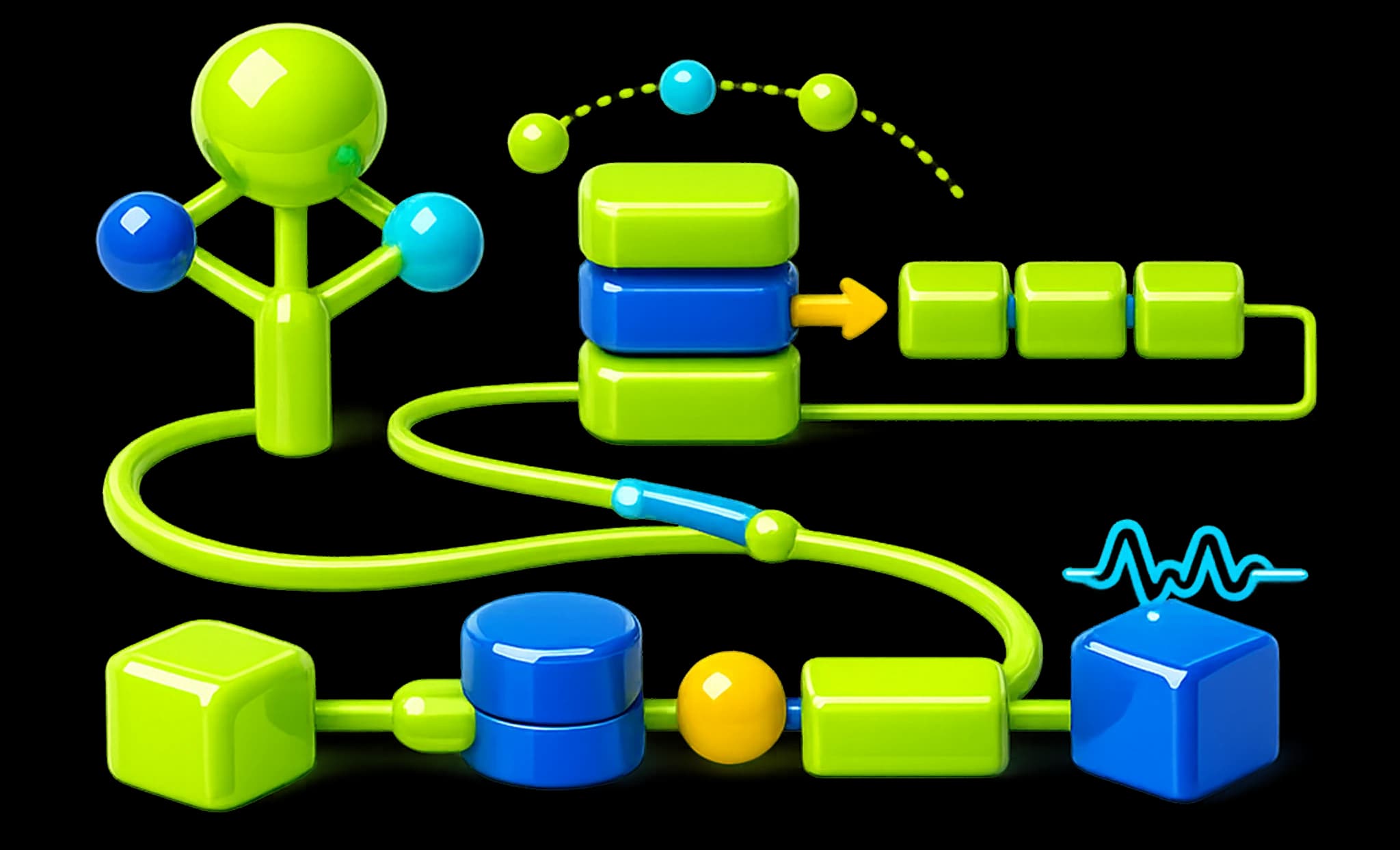
RAG Systems (Retrieval-Augmented Generation)
Build RAG systems that combine retrieval with LLM generation for context-grounded, context-aware AI
Large Language Models are powerful — but unreliable when they operate without context. RAG (Retrieval-Augmented Generation) solves this by grounding AI responses in your real data. H-Studio designs and builds production-grade RAG systems that combine semantic retrieval with LLM generation to deliver context-grounded, explainable, and up-to-date AI outputs designed to reduce hallucinations.
This is one of the ways AI can be made more usable in real products, operations, and enterprise systems.
What RAG Systems Are (and Why They Matter)
RAG systems connect LLMs with external knowledge sources: Instead of generating responses without context, the model retrieves relevant information first, then generates responses based on retrieved context. This supports:
databases
documents
APIs
internal systems
real-time data
What RAG Enables
What We Build with RAG
Knowledge-Grounded AI
- internal knowledge assistants
- enterprise search & Q&A
- documentation bots
- compliance-aware AI tools
Product & Customer Use Cases
- support assistants with context-grounded answers
- AI copilots for users or employees
- semantic search across large datasets
- AI interfaces for complex systems
RAG Architecture We Implement
Data Ingestion & Knowledge Modeling
- We structure your data properly:
- documents (PDF, DOCX, HTML)
- databases & APIs
- tickets, CRM records, logs
- multilingual content
- Everything is normalized, chunked, and indexed semantically.
Vector Search & Retrieval
- We implement:
- high-quality embeddings
- vector databases (Postgres, specialized stores)
- hybrid search (semantic + keyword)
- relevance scoring & filtering
- Retrieval quality determines generation quality.
LLM Integration & Prompt Engineering
- We connect retrieval to generation:
- prompt templates
- context injection
- citation & source control
- answer constraints & formatting
- The model is configured to prioritize retrieved context over unconstrained generation.
Governance, Control & Monitoring
- Production RAG requires control:
- confidence thresholds
- fallback logic
- logging & traceability
- performance & cost monitoring
- access control & permissions
Typical RAG Use Cases
Who RAG Is For
- companies with large knowledge bases
- enterprises requiring higher levels of control and transparency in AI outputs
- products requiring explainability
- regulated industries
- teams replacing brittle chatbots
Every engagement begins with an Architecture Sprint
Five working days. One senior engineer. A clear map of system boundaries, scaling risks, stack decisions, and a delivery roadmap — before a single line of production code.
- 01Day 1
Discovery: domain, constraints, growth targets
- 02Day 2
System mapping: services, data, integrations
- 03Day 3-4
Stack decisions and risk model
- 04Day 5
Roadmap & costed delivery plan
Ready to start with architecture, not features?
Five days. One senior engineer. A clear path forward.
Or talk to us first Get in touch
FAQ
Fine-tuning trains a model on your data, which is expensive, slow to update, and can't access real-time information. RAG retrieves relevant information at query time and uses it as context for generation. RAG is faster to deploy, easier to update, and can access live data sources.
We enforce strict constraints: the LLM is constrained to prioritize retrieved context and applies fallback logic when context quality is insufficient, we use confidence thresholds, we implement citation requirements, and we add fallback logic when retrieval quality is low. We also monitor outputs and log all generations for auditability.
RAG can retrieve from documents (PDF, DOCX, HTML), databases, APIs, CRM/ERP systems, knowledge bases, wikis, and real-time data streams. We structure and index everything semantically so the system can find relevant information quickly.
A basic RAG system (data ingestion + retrieval + LLM integration) typically takes 6-10 weeks. Complex RAG with multiple data sources, advanced retrieval logic, and extensive governance can take 12-20 weeks. We start with an architecture review to define scope.
Yes — we build multilingual RAG systems that handle, English, and other languages. We use multilingual embeddings, language-aware retrieval, and prompt engineering that respects language boundaries. RAG systems can answer in the language of the query.
Related Services
Keep reading from the blog
More insights and best practices on this topic.
RAG systems development for companies building production AI systems. We support organizations with RAG architecture, vector search, and LLM integration based on the specific technical and regulatory context of each project. All services are delivered individually and depend on system requirements and constraints.
RAG systems are probabilistic AI systems. While retrieval significantly improves contextual grounding, outputs may still vary depending on data quality, retrieval performance, and model behavior. RAG systems support decision-making and information access but do not replace human review, validation, or responsibility.